Finding Your Perfect Watch Size
What is the right watch size for your wrist?
The simple answer is that there isn't one.
Not all of us have the same wrist size or even the same wrist shape. Everyone is built differently. We might see photos online of a watch we love, or see someone like me post a watch and think, that's perfect. Then we finally try it on and realize we're not happy with the way it wears.
This is especially difficult when you're looking at microbrands or other watches that aren't readily available at a traditional boutique. Sometimes you simply don't have the opportunity to try before you buy.
So how do you figure out what works for you?
Start With Your Wrist
First, measure your wrist just behind the wrist bone, where most people traditionally wear their watch.
And remember that your wrist isn't necessarily the exact same size all year. Heat can cause your wrist to swell slightly, which is one reason on-the-fly micro-adjustment systems have become such a welcome feature on modern bracelets and clasps.
For me, my wrist measures somewhere between 7.25 and 7.5 inches, depending on the time of day and time of year. Where I live, it gets extremely hot during the summer, so that's something I have to consider.
Luckily, there's no shortage of watches I like that fit me well. Generally, watches in the 39mm–44mm range work for my wrist. But that number alone doesn't tell me whether a watch will actually fit the way I want it to.
A 43mm watch can fit beautifully. Another 43mm watch can feel completely wrong.
That's because case diameter is only the beginning.
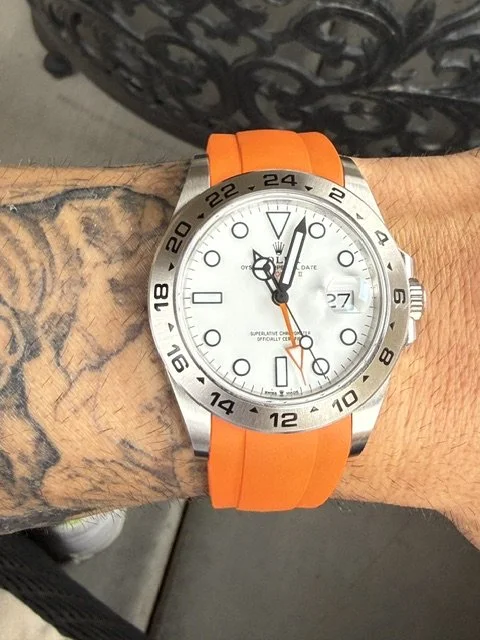
My 42mm Rolex Explorer II on my 7.25–7.5-inch wrist. Diameter gives you a starting point, but it doesn't tell the entire story.
Lug-to-Lug May Matter More Than Diameter
Don't see 41mm on a spec sheet and automatically assume you know how that watch is going to wear.
One of the most important measurements is lug-to-lug: the distance from the tip of the upper lugs to the tip of the lower lugs. It gives you a much better idea of how much space the watch will actually occupy across your wrist.
Unfortunately, not every manufacturer makes this measurement easy to find.
A good example is the Hamilton Khaki Field. Some versions have relatively long lugs for their case diameter, which can make the watch wear larger than the diameter alone might suggest.
Personally, I don't want the lugs hanging over the edges of my wrist. I want the watch to sit naturally on top of it.
But lug-to-lug isn't the entire story either.
Look at the Shape of the Lugs
Are they flat? Do they curve downward toward the wrist?
That can dramatically change how a watch wears.
My Rolex Yacht-Master 40, for example, sits beautifully on my wrist. The shape of the case and lugs helps the watch almost conform to my wrist. Compare that with watches like the Submariner or Explorer II, and you'll notice differences in how the case presents itself and sits on the wrist.
Those details don't necessarily show up when you're comparing diameter measurements online.
That's why two watches with similar dimensions can feel completely different once they're actually on your wrist.
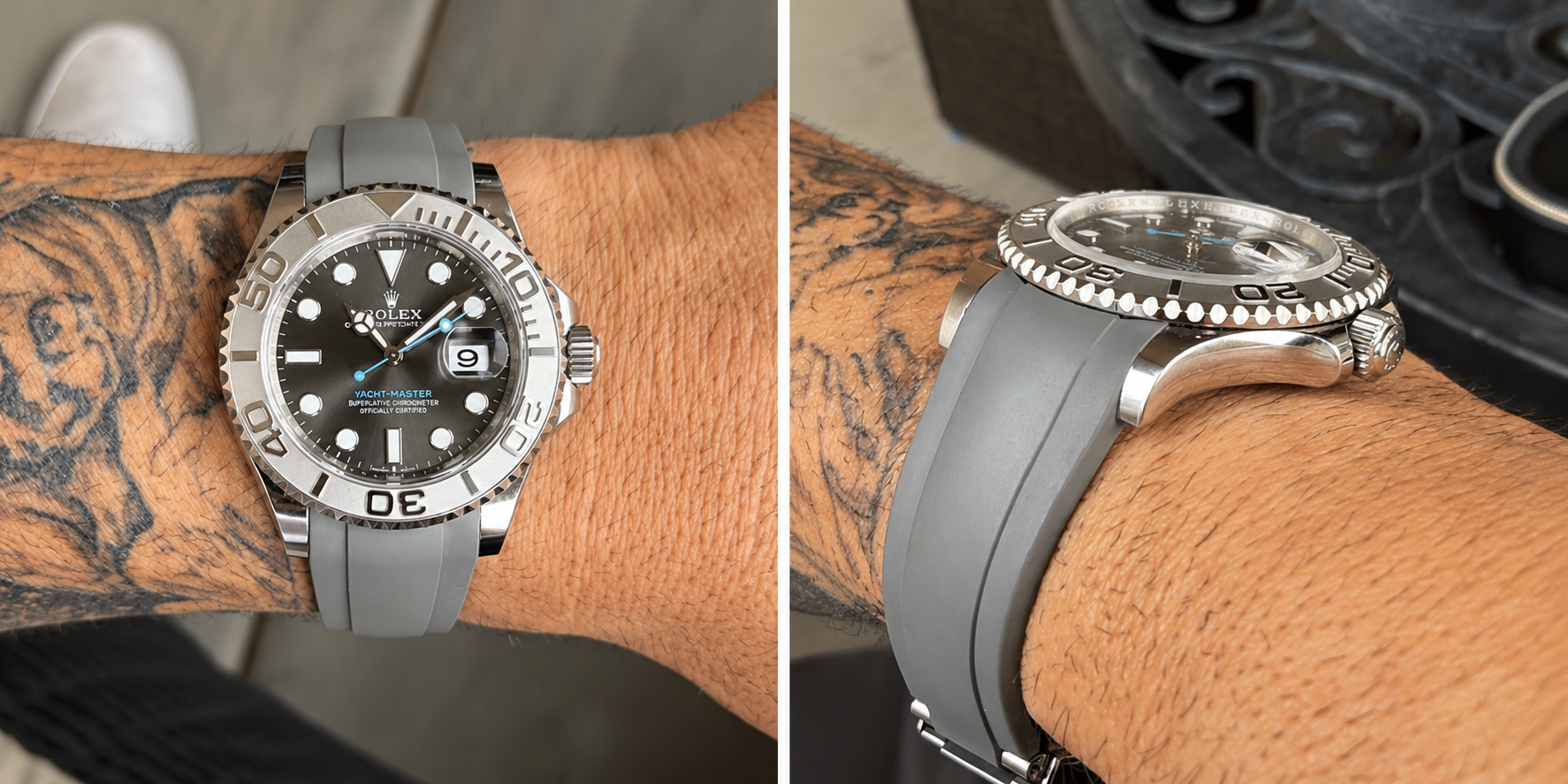
The Yacht-Master 40 from two angles. Notice how the case and lugs curve toward the wrist rather than simply looking at the 40mm diameter.
Don't Ignore Thickness
Thickness may be the most underrated measurement for me.
I want a watch to feel proportional to its overall size.
Of course, certain complications naturally require more space. Chronographs, for example, are traditionally thicker than simple three-hand watches. That's understandable.
But proportions still matter.
A smaller-diameter watch paired with a relatively thick case can sometimes feel taller or more substantial than you'd expect from the diameter alone. The Tudor Black Bay Pro, for example, is 39mm across but has historically had a comparatively thick, slab-sided case profile. On some wrists that works perfectly. On others, it can feel much larger than “39mm” suggests.
Depending on the complication and overall design, I personally tend to gravitate toward watches under roughly 13.5mm thick.
But that's exactly what it is: my preference.
Yours may be completely different.
You also have to consider where you're going to wear the watch. If I wore a suit every day, an especially thick watch probably wouldn't work for me because I'd want something that slips comfortably underneath a shirt cuff.
This is one area where Rolex tends to get a lot right. The brand gets plenty of love and plenty of criticism because of its popularity, but many of its longstanding models have very wearable proportions. There's a reason designs like the Submariner have remained recognizable—and wearable—for generations.
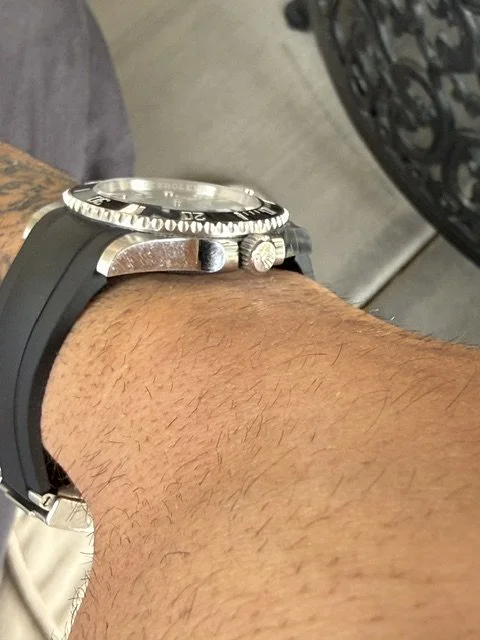
Case thickness is easier to understand from the side. Diameter alone can't show you how high a watch will sit on the wrist.
How You Look at the Watch Matters
Here's something I don't think people talk about enough.
When you try on a watch and take a picture to decide whether it looks right, the angle of the photograph matters.
The standard phone photo—looking straight down at your wrist—doesn't tell the whole story. The camera is close to the watch, which can distort how large it appears relative to your wrist.
Instead, use a full-length mirror if the boutique has one. Most do.
Let your arm hang naturally at your side and look at the watch in the mirror. Better yet, take a picture from that perspective.
That gives you a much better idea of how the watch actually looks on you, rather than how it looks through a phone camera six inches away.
Same Watch. Same Wrist. Different Perspective.
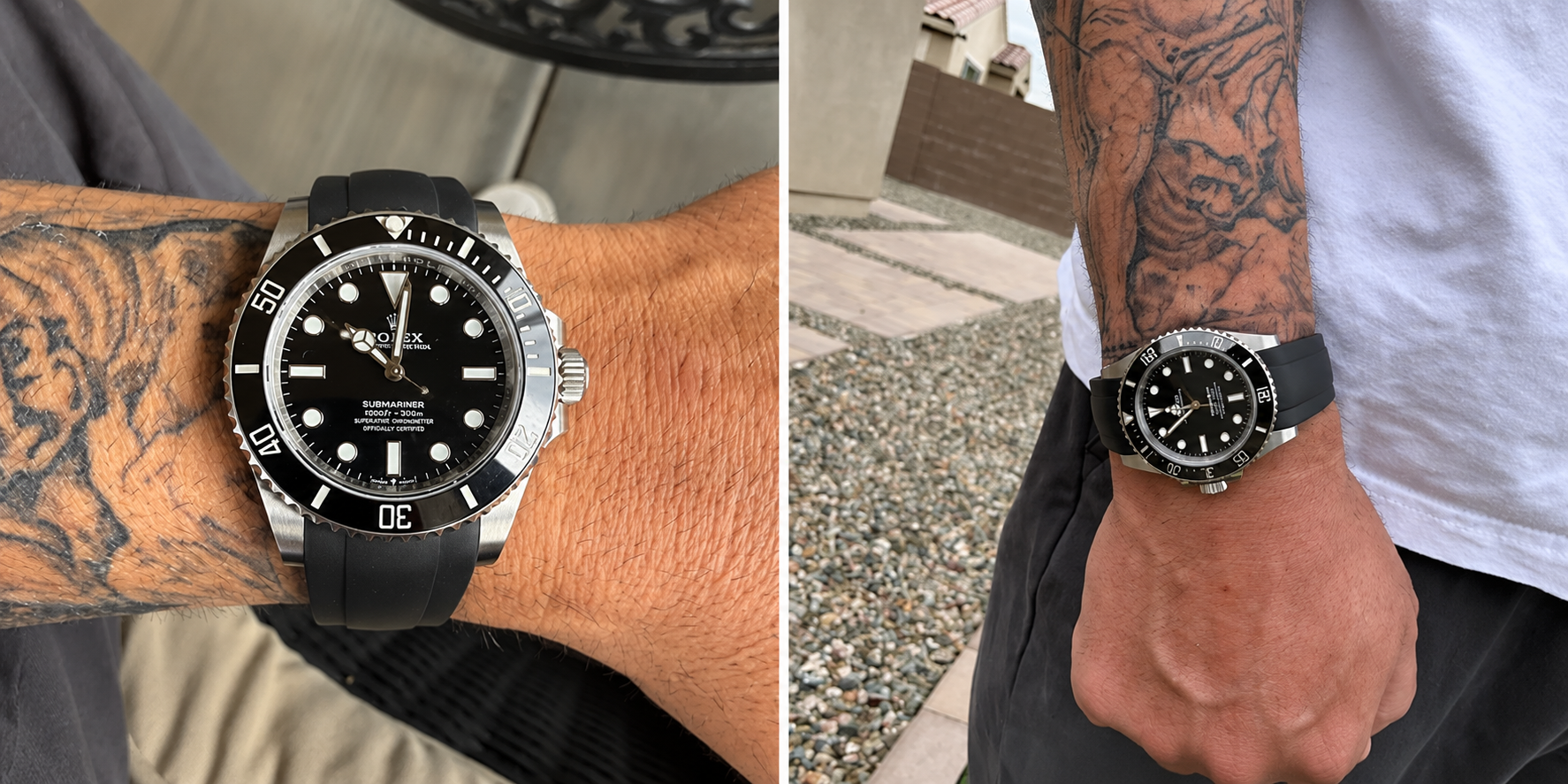
Same watch. Same wrist. Nothing about the fit changed. Only the viewing distance and perspective did.
I've had to accept this myself.
One of my favorite current watches is the Breitling Avenger GMT. I genuinely love that watch.
But it just doesn't work for me.
It doesn't sit on my wrist the way I prefer, and the lugs either approach or slightly extend beyond where I want them to sit. I've tried it, looked at it from different angles, and wanted it to work.
It doesn't.
And that's okay.
The same thing can happen on the other end of the spectrum. If you have a smaller wrist and absolutely love a larger watch like the Rolex Explorer II 226570, you may try it on and decide that it simply doesn't wear the way you want.
Luckily, brands like Grand Seiko, Tudor, and plenty of others offer alternatives across a wide range of sizes and proportions.
Don't Buy a Size Because the Internet Told You To
Watch sizing trends change.
Large watches become popular. Then smaller watches come back. Suddenly everyone says 36mm is perfect. A few years later, something else will be considered the “correct” size.
I don't think you should buy a watch based on whatever size happens to be fashionable online.
Vintage watches and family heirlooms are another matter entirely. If I'm wearing a watch that belonged to my father or grandfather, I'm not particularly concerned whether the internet thinks it's too small for my wrist.
The story matters more than the measurement.
For everything else, I'd rather buy the watch that looks and feels right to me than chase whatever size is currently popular.
Take Someone With You
Finally, if possible, take a friend or significant other with you when you're shopping for a watch.
Have them take a picture from farther away. Ask how the watch looks from a normal distance. Walk around with it for a few minutes if the boutique allows it.
You don't have to let someone else make the decision for you, but another perspective can help—especially when you're considering an expensive purchase.
And then make the decision yourself.
Because at the end of the day, all of these measurements—diameter, lug-to-lug, thickness, wrist circumference—are guides, not rules.
Some watches are expensive. You don't want to spend that kind of money only to realize you bought the watch everyone else told you should fit rather than the one you actually enjoy wearing.
Buy what you love. Wear what you buy.
The perfect watch size isn't a number on a spec sheet.
It's the one that feels right when it's on your wrist.
Memento Temporis — Remember Time.
