Phil C Phil C

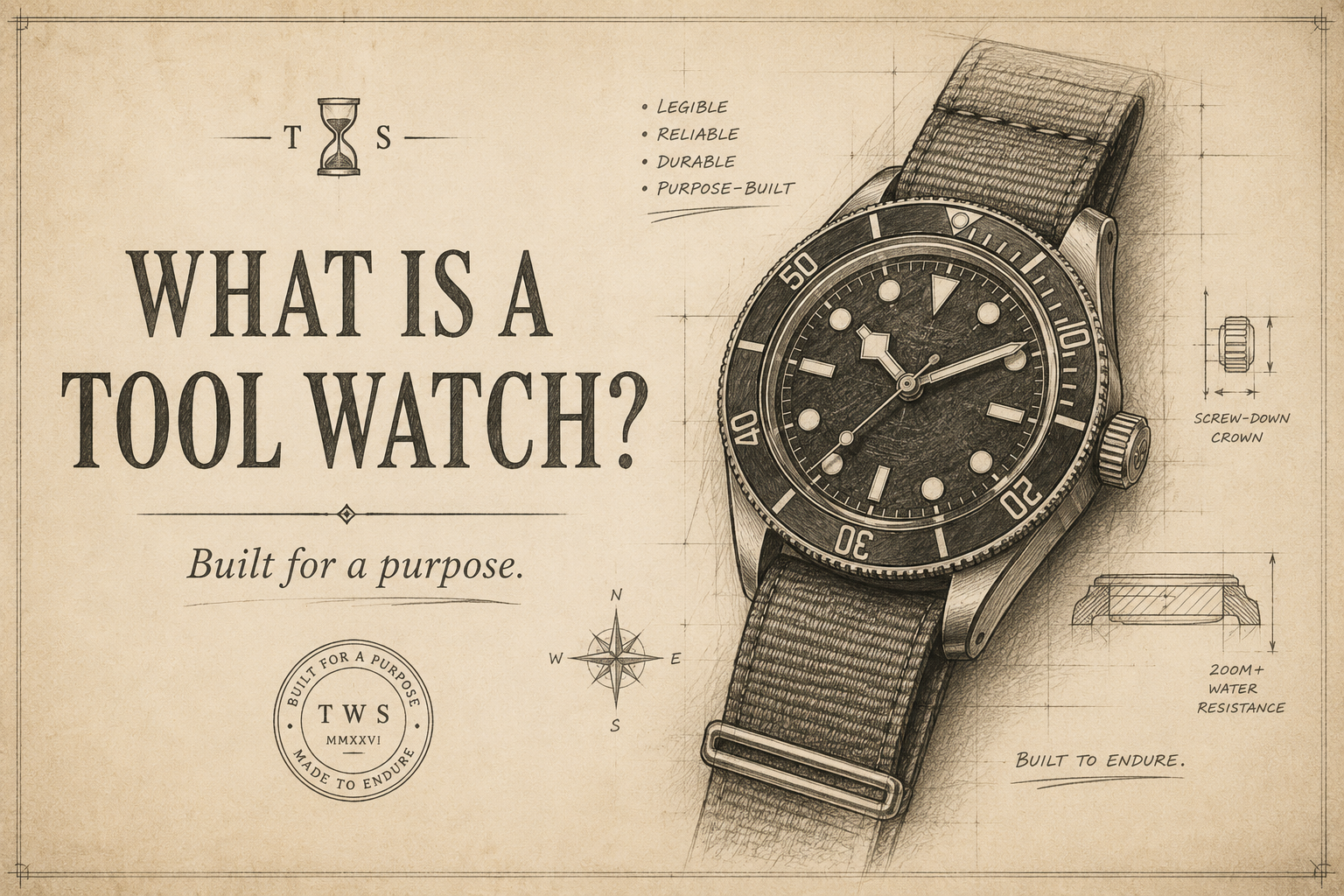
What Is a Tool Watch?

From dive watches to GMTs, tool watches were built with a purpose. Here’s how function shaped some of the most recognizable watches in the world.

A tool watch is, at its core, a watch designed to perform a specific function.

Of course, you could argue that every watch is a tool—it tells the time. But tool watches go a step further. They were designed with a job in mind, whether that meant helping a pilot navigate, a diver track time underwater, a soldier read the time in the dark, or a traveler keep track of multiple time zones.

That purpose-first philosophy is what makes tool watches so interesting to me. They weren’t originally designed to sit in a display case. They were designed to be used.

Built for the Job

The idea of a tool watch is almost as old as the wristwatch itself.

In the early days of wristwatches, wearing a watch on your wrist wasn’t simply a matter of convenience or style. In many cases, it solved a very real problem: sometimes reaching for a pocket watch just wasn’t practical.

One of the most famous examples came in the early 1900s, when Brazilian aviator Alberto Santos-Dumont reportedly complained to his friend Louis Cartier about the difficulty of checking a pocket watch while flying. Cartier’s solution was a watch that could be worn on the wrist, allowing Santos-Dumont to check the time while keeping his hands on the controls.

Whether on the wrist of a pilot, soldier, diver, explorer, or traveler, the same basic idea would continue to shape watches for decades:

Identify the job. Build the watch to do it.

Over time, those jobs helped create some of the most recognizable categories of tool watches we know today.

Built for the Field

A field watch was designed first and foremost to be highly legible, rugged, and reliable.

Their history is closely connected to military use, particularly during the World Wars. Watches like the famous A-11 “Dirty Dozen” helped establish a design language that can still be seen in field watches today: simple dials, large numerals, easy-to-read hands, durable cases, and very little that doesn’t serve a purpose.

Modern field watches generally follow that same philosophy. Rather than complicated features or functional bezels, the emphasis is on an easy-to-read dial, a rugged movement, reasonable water resistance, and lume that allows the wearer to tell the time in darkness.

Historically, they’ve also tended to be modest in size and commonly paired with leather, canvas, or NATO-style straps. Most are straightforward three-handers: hours, minutes, and seconds.

Function above everything else.

I’ll admit, field watches aren't usually what I personally gravitate toward. But I genuinely appreciate their heritage and design. There’s something cool about a watch that makes absolutely no attempt to be anything other than what it needs to be.

That appreciation grew even more when I toured the U.S. Army National Infantry Museum and had the opportunity to see military watches on display.

Built for the Depths

A dive watch was designed around a simple but critical need: keeping track of time underwater.

As recreational and professional diving grew in the 20th century, divers needed watches that could withstand increasing water pressure while remaining easy to read in dark, difficult conditions. That meant robust cases, strong water resistance, luminous hands and markers, and eventually one of the dive watch’s most recognizable features: the rotating timing bezel.

The bezel allowed a diver to track elapsed time underwater at a glance. Modern dive watches typically use a unidirectional bezel, designed to rotate in only one direction. If it’s accidentally moved during a dive, it can only indicate that more time has elapsed—not less. It’s a small design choice with a very practical purpose.

At the bezel’s zero marker, you’ll also typically find a luminous pip. Like the lume on the dial, it helps the diver see the bezel’s starting point in low-light conditions, making it easier to track elapsed time when visibility is limited.

Legibility matters just as much. Large markers, strong contrast, and generous lume help make the dial readable when visibility is limited. Screw-down crowns and robust case construction help protect the movement from water and pressure.

And while most dive watches today will probably never see anything deeper than a swimming pool, their design still reflects the environment they were originally built to survive.

There’s a reason the dive watch has become one of the most recognizable watch designs in the world. Even when you take it out of the water, every part of it still looks like it has a job to do.

Built for the Cockpit

Pilot watches were born from a problem that seems almost obvious today: a pilot needed to know the time without taking their hands off the controls.

In the early days of aviation, that wasn’t as simple as glancing at your wrist. Pocket watches were still common, and pulling one out while flying an aircraft was hardly practical. As aviation evolved, so did watches designed specifically for the people in the cockpit.

Legibility became everything. Large dials, bold numerals, high-contrast hands, and luminous markings made it possible to read the time quickly in changing light and difficult conditions. Many early pilot watches also featured oversized crowns, allowing them to be adjusted while wearing gloves.

But time in the cockpit wasn’t just about knowing whether you were running late. Before modern navigation systems, pilots relied on time alongside speed, distance, and direction to help calculate their position and navigate a route. Later aviation watches added functions like chronographs, rotating bezels, and additional time zones as the needs of pilots became more complex.

Like the best tool watches, nearly every recognizable feature of a traditional pilot watch exists because someone needed it to do a job.

And there’s something I love about that. Many pilot watches are big, bold, and impossible to miss—but historically, that presence wasn’t about making a statement.

It was about making the time impossible to miss.

Built for More Than One Time Zone

A GMT watch was designed around a simple idea: keeping track of more than one time zone at once.

GMT stands for Greenwich Mean Time, while UTC — Coordinated Universal Time — is the modern global time standard. In the watch world, the terms are often used somewhat interchangeably when describing watches capable of displaying an additional time zone.

The defining feature is an additional hour hand, commonly called a GMT hand, that makes one full rotation every 24 hours. Paired with a 24-hour scale on the dial or bezel, it allows the wearer to read a second time zone alongside local time.

These watches became particularly useful as international air travel expanded. Pilots, crews, and travelers increasingly found themselves crossing multiple time zones, creating a very practical need to keep track of both local time and the time back home.

Some GMT watches take the idea even further. A rotating 24-hour bezel can allow the wearer to track a third time zone, turning a relatively simple mechanical concept into an incredibly useful travel tool.

One watch. More than one place.

This is one of those tool-watch complications I personally love because the function is immediately understandable. A GMT may be built for crossing time zones, but part of its appeal is simpler: no matter how far you travel, home is always there on your wrist.

Built to Measure

A chronograph takes the basic function of a watch one step further. Instead of simply telling you the time, it allows you to measure elapsed time on demand.

At its simplest, a chronograph is essentially a stopwatch built into a wristwatch. Pushers on the side of the case allow the wearer to start, stop, and reset a separate timing mechanism, while subdials can record elapsed minutes and hours.

The complication became especially useful anywhere precise timing mattered. Chronographs found their way onto the wrists of pilots, racing drivers, engineers, military personnel, and even astronauts. Depending on the watch, additional scales could make them even more specialized.

One of the most recognizable is the tachymeter, which can be used with the chronograph to calculate speed over a known distance. Other chronographs have used scales designed for everything from measuring distance to monitoring heart rates.

And despite how complicated some chronograph dials can look, the underlying idea is remarkably straightforward:

Start. Stop. Measure.

I think that’s part of what makes chronographs so interesting. All of those subdials, pushers, hands, and markings aren’t just there for decoration. At least originally, every one of them had a job to do.

Built for the Real World

Not every tool watch has hands, gears, or a mechanical movement. Some of the most capable tool watches are digital.

Digital watches took the same purpose-first philosophy behind traditional tool watches and expanded what could be carried on the wrist. With quartz accuracy and a digital display, a single watch could provide multiple useful functions at once while remaining durable, reliable, and relatively simple to operate.

Stopwatches, countdown timers, alarms, backlights, calendars, and multiple time zones became common features. More specialized digital tool watches pushed the idea even further, adding functions such as compasses, altimeters, barometers, depth measurements, and eventually GPS.

Their usefulness also isn't tied to one particular environment. Digital tool watches have been worn by athletes, military personnel, first responders, divers, hikers, explorers, and everyday users who simply need something dependable on their wrist.

And that's part of what makes them interesting. A tool watch doesn't have to be mechanical. It doesn't have to be expensive. And it certainly doesn't have to be luxurious.

Different watches. Different environments. Same basic idea:

Give the wearer the information they need, when they need it.

There's something refreshing about that simplicity. Digital tool watches aren't trying to impress anyone. At their best, they're designed to work, take a beating, and be ready when they're needed.

That, as much as anything else in this article, is what makes a watch a tool watch.

So, What Makes a Tool Watch?

A field watch and a dive watch may look completely different. A chronograph may be filled with subdials while a digital watch displays everything on a screen. One was built for the battlefield, another for the ocean, another for the cockpit, and another simply to keep track of more than one place at a time.

But they all share the same philosophy:

Purpose comes first.

A tool watch was designed to solve a problem. Its features exist for a reason. Legibility matters. Reliability matters. Durability matters. And whether that means a rotating bezel, a GMT hand, a chronograph pusher, luminous markers, or a digital display depends entirely on the job it was built to do.

Today, most of us probably aren't using these watches for the jobs that originally inspired them. A dive watch might never go deeper than a swimming pool. A GMT might spend its entire life in one time zone. A chronograph may be used more often to time dinner than a lap around a racetrack.

And that's okay.

Because part of what makes tool watches special is that their purpose doesn't disappear just because our reason for wearing them has changed. The history is still there. The function is still there. And the idea behind them is still there.

They were built to be used.

And I think they still should be.

Wear the watch. Make the memories. Remember the time.

Memento Temporis.

Read More