
Finding Your Perfect Watch Size
Finding the right watch size isn't just about case diameter. Lug-to-lug, thickness, case shape, wrist size and even how you view the watch can completely change how it wears. Here's how to find the size that works for you.
What is the right watch size for your wrist?
The simple answer is that there isn't one.
Not all of us have the same wrist size or even the same wrist shape. Everyone is built differently. We might see photos online of a watch we love, or see someone like me post a watch and think, that's perfect. Then we finally try it on and realize we're not happy with the way it wears.
This is especially difficult when you're looking at microbrands or other watches that aren't readily available at a traditional boutique. Sometimes you simply don't have the opportunity to try before you buy.
So how do you figure out what works for you?
Start With Your Wrist
First, measure your wrist just behind the wrist bone, where most people traditionally wear their watch.
And remember that your wrist isn't necessarily the exact same size all year. Heat can cause your wrist to swell slightly, which is one reason on-the-fly micro-adjustment systems have become such a welcome feature on modern bracelets and clasps.
For me, my wrist measures somewhere between 7.25 and 7.5 inches, depending on the time of day and time of year. Where I live, it gets extremely hot during the summer, so that's something I have to consider.
Luckily, there's no shortage of watches I like that fit me well. Generally, watches in the 39mm–44mm range work for my wrist. But that number alone doesn't tell me whether a watch will actually fit the way I want it to.
A 43mm watch can fit beautifully. Another 43mm watch can feel completely wrong.
That's because case diameter is only the beginning.
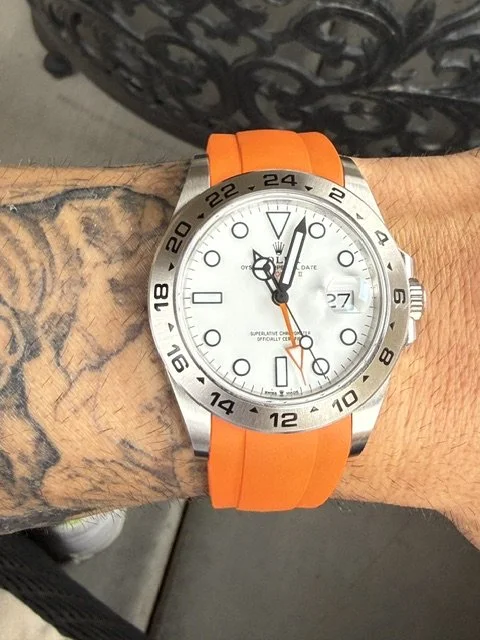
My 42mm Rolex Explorer II on my 7.25–7.5-inch wrist. Diameter gives you a starting point, but it doesn't tell the entire story.
Lug-to-Lug May Matter More Than Diameter
Don't see 41mm on a spec sheet and automatically assume you know how that watch is going to wear.
One of the most important measurements is lug-to-lug: the distance from the tip of the upper lugs to the tip of the lower lugs. It gives you a much better idea of how much space the watch will actually occupy across your wrist.
Unfortunately, not every manufacturer makes this measurement easy to find.
A good example is the Hamilton Khaki Field. Some versions have relatively long lugs for their case diameter, which can make the watch wear larger than the diameter alone might suggest.
Personally, I don't want the lugs hanging over the edges of my wrist. I want the watch to sit naturally on top of it.
But lug-to-lug isn't the entire story either.
Look at the Shape of the Lugs
Are they flat? Do they curve downward toward the wrist?
That can dramatically change how a watch wears.
My Rolex Yacht-Master 40, for example, sits beautifully on my wrist. The shape of the case and lugs helps the watch almost conform to my wrist. Compare that with watches like the Submariner or Explorer II, and you'll notice differences in how the case presents itself and sits on the wrist.
Those details don't necessarily show up when you're comparing diameter measurements online.
That's why two watches with similar dimensions can feel completely different once they're actually on your wrist.
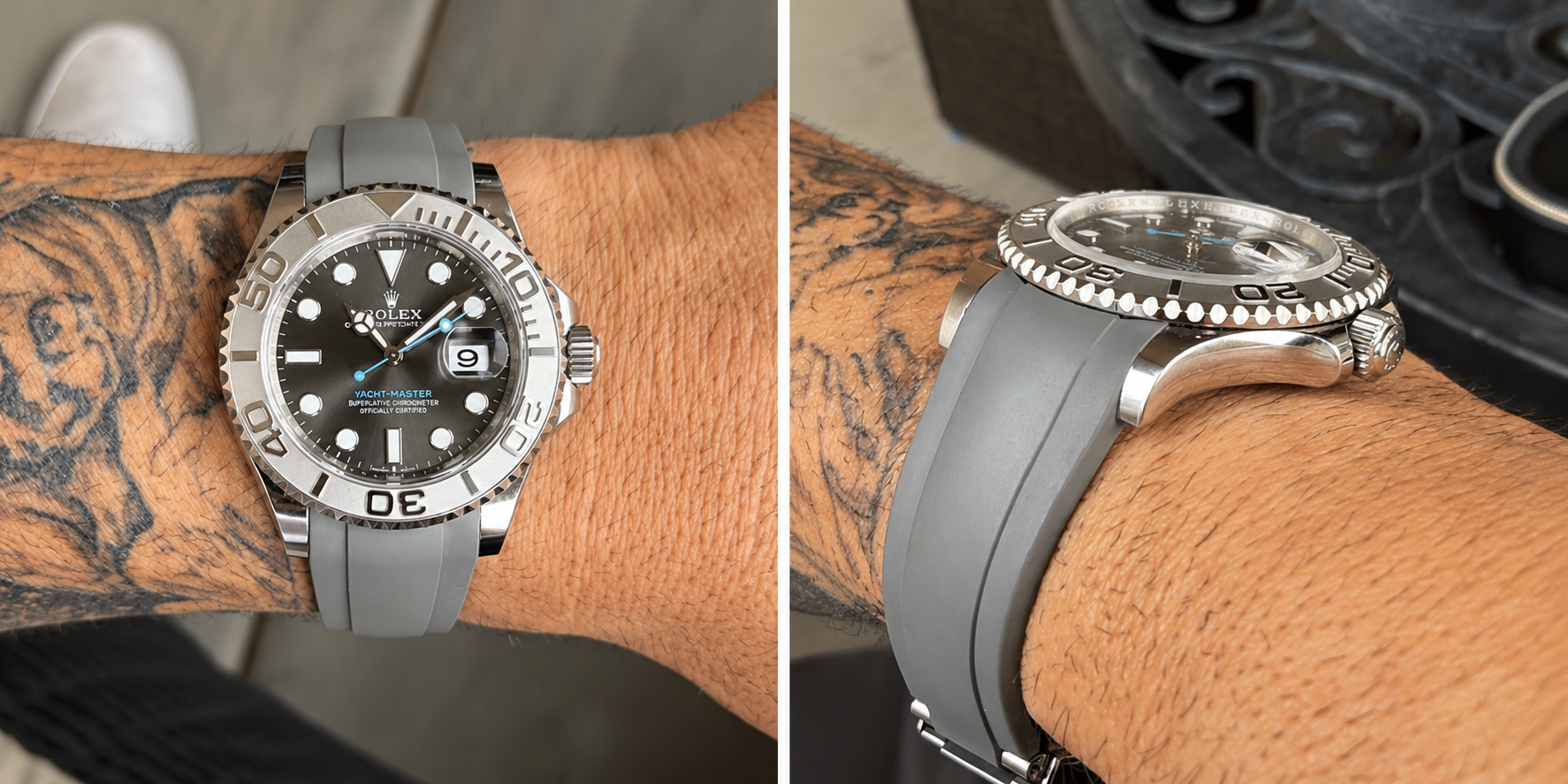
The Yacht-Master 40 from two angles. Notice how the case and lugs curve toward the wrist rather than simply looking at the 40mm diameter.
Don't Ignore Thickness
Thickness may be the most underrated measurement for me.
I want a watch to feel proportional to its overall size.
Of course, certain complications naturally require more space. Chronographs, for example, are traditionally thicker than simple three-hand watches. That's understandable.
But proportions still matter.
A smaller-diameter watch paired with a relatively thick case can sometimes feel taller or more substantial than you'd expect from the diameter alone. The Tudor Black Bay Pro, for example, is 39mm across but has historically had a comparatively thick, slab-sided case profile. On some wrists that works perfectly. On others, it can feel much larger than “39mm” suggests.
Depending on the complication and overall design, I personally tend to gravitate toward watches under roughly 13.5mm thick.
But that's exactly what it is: my preference.
Yours may be completely different.
You also have to consider where you're going to wear the watch. If I wore a suit every day, an especially thick watch probably wouldn't work for me because I'd want something that slips comfortably underneath a shirt cuff.
This is one area where Rolex tends to get a lot right. The brand gets plenty of love and plenty of criticism because of its popularity, but many of its longstanding models have very wearable proportions. There's a reason designs like the Submariner have remained recognizable—and wearable—for generations.
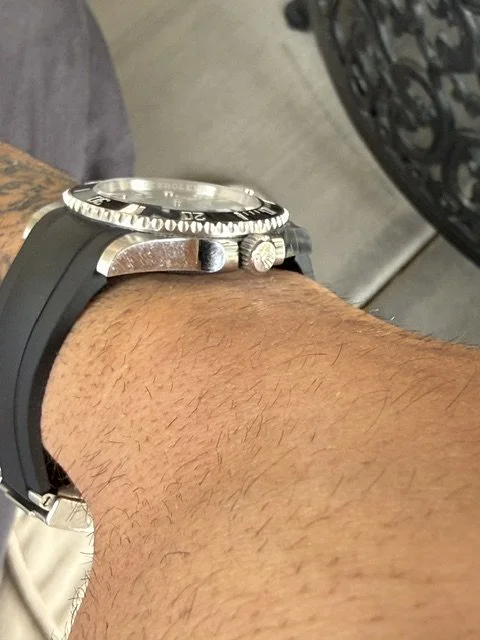
Case thickness is easier to understand from the side. Diameter alone can't show you how high a watch will sit on the wrist.
How You Look at the Watch Matters
Here's something I don't think people talk about enough.
When you try on a watch and take a picture to decide whether it looks right, the angle of the photograph matters.
The standard phone photo—looking straight down at your wrist—doesn't tell the whole story. The camera is close to the watch, which can distort how large it appears relative to your wrist.
Instead, use a full-length mirror if the boutique has one. Most do.
Let your arm hang naturally at your side and look at the watch in the mirror. Better yet, take a picture from that perspective.
That gives you a much better idea of how the watch actually looks on you, rather than how it looks through a phone camera six inches away.
Same Watch. Same Wrist. Different Perspective.
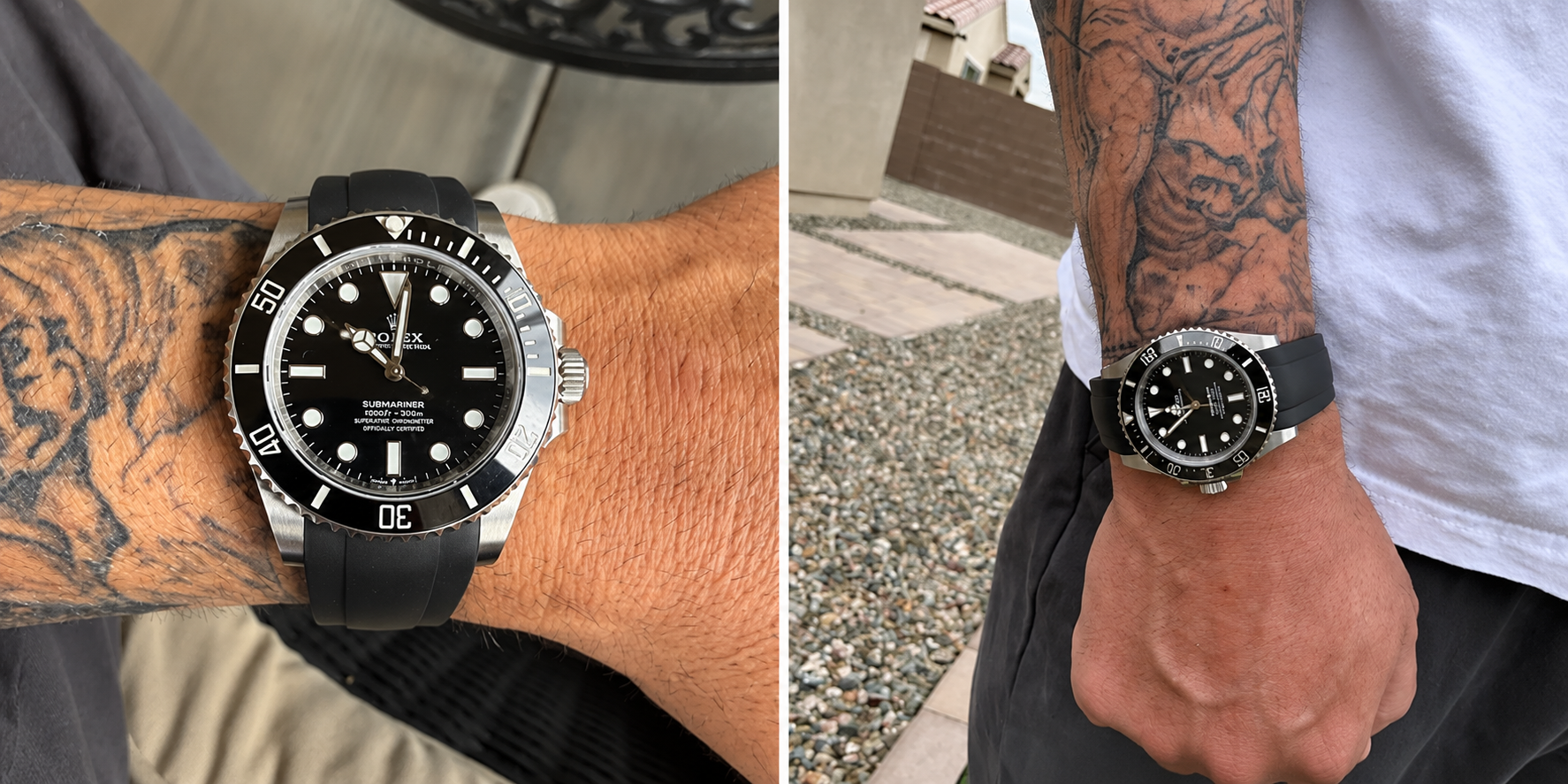
Same watch. Same wrist. Nothing about the fit changed. Only the viewing distance and perspective did.
I've had to accept this myself.
One of my favorite current watches is the Breitling Avenger GMT. I genuinely love that watch.
But it just doesn't work for me.
It doesn't sit on my wrist the way I prefer, and the lugs either approach or slightly extend beyond where I want them to sit. I've tried it, looked at it from different angles, and wanted it to work.
It doesn't.
And that's okay.
The same thing can happen on the other end of the spectrum. If you have a smaller wrist and absolutely love a larger watch like the Rolex Explorer II 226570, you may try it on and decide that it simply doesn't wear the way you want.
Luckily, brands like Grand Seiko, Tudor, and plenty of others offer alternatives across a wide range of sizes and proportions.
Don't Buy a Size Because the Internet Told You To
Watch sizing trends change.
Large watches become popular. Then smaller watches come back. Suddenly everyone says 36mm is perfect. A few years later, something else will be considered the “correct” size.
I don't think you should buy a watch based on whatever size happens to be fashionable online.
Vintage watches and family heirlooms are another matter entirely. If I'm wearing a watch that belonged to my father or grandfather, I'm not particularly concerned whether the internet thinks it's too small for my wrist.
The story matters more than the measurement.
For everything else, I'd rather buy the watch that looks and feels right to me than chase whatever size is currently popular.
Take Someone With You
Finally, if possible, take a friend or significant other with you when you're shopping for a watch.
Have them take a picture from farther away. Ask how the watch looks from a normal distance. Walk around with it for a few minutes if the boutique allows it.
You don't have to let someone else make the decision for you, but another perspective can help—especially when you're considering an expensive purchase.
And then make the decision yourself.
Because at the end of the day, all of these measurements—diameter, lug-to-lug, thickness, wrist circumference—are guides, not rules.
Some watches are expensive. You don't want to spend that kind of money only to realize you bought the watch everyone else told you should fit rather than the one you actually enjoy wearing.
Buy what you love. Wear what you buy.
The perfect watch size isn't a number on a spec sheet.
It's the one that feels right when it's on your wrist.
Memento Temporis — Remember Time.
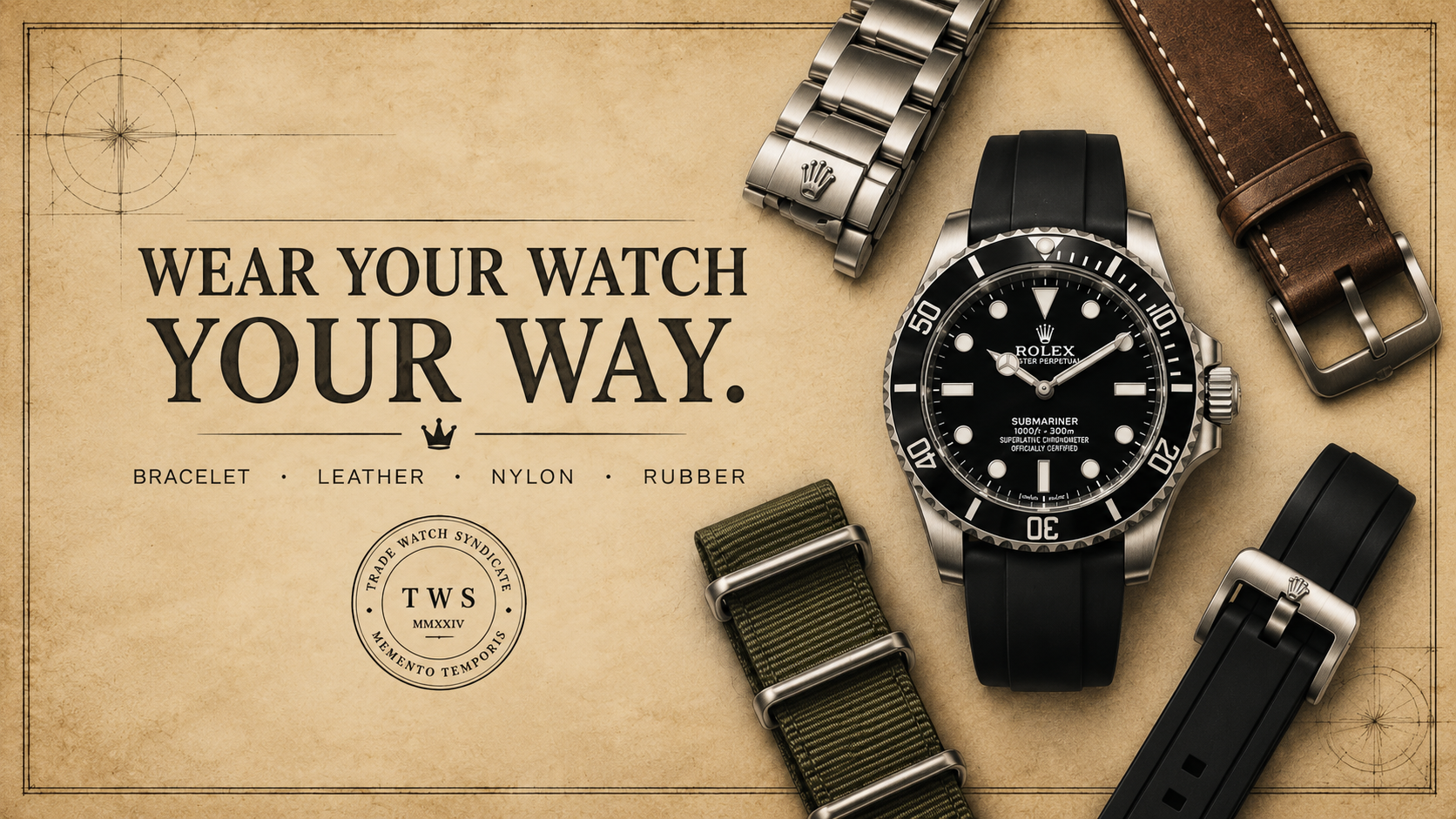
Wear Your Watch Your Way
Your watch doesn’t have to stay exactly as it came from the catalog. From bracelets and leather to nylon, rubber and sailcloth, the way you wear your watch is personal. Explore the options, change it up and wear your watch your way.
There’s a version of the Rifleman’s Creed famously heard in Full Metal Jacket that begins:
“This is my rifle. There are many like it, but this one is mine.”
I’ve always liked that sentiment. Not because I’m comparing a watch to a rifle, but because the idea applies to a lot of the things we choose to carry through life. There may be thousands of watches exactly like yours, but this one is yours.
And once it’s yours, I think you should wear it however the hell you want.
I’ve always been a rubber strap guy. I wear a rubber wedding ring. I prefer rubber straps on my watches. To me, bracelets sometimes make a watch feel more like jewelry, and that’s just not what I’m looking for most of the time. That doesn’t mean bracelets are bad. Far from it. Some watches look incredible on them. They’re just not always for me.
My Rolex 124060? I prefer it on rubber.
I know. Somewhere, a Rolex purist just felt a disturbance in the Force.
But that’s kind of the point. It’s my watch.
Bracelet
For many watches, the bracelet is part of the identity. Think about a vintage Submariner on an Oyster bracelet. There’s something undeniably right about it—the weight, the feel, the way the bracelet integrates with the case. It’s the configuration most people picture when they think of the watch.
Modern bracelets have also become incredibly good. Better clasps, micro-adjustment, improved finishing and more comfortable links have made them far more wearable than some of their predecessors. For plenty of people, the bracelet is exactly where the watch belongs.
But it doesn’t have to stay there forever.
Taking a bracelet off can completely change the personality of a watch, and sometimes that’s the fun of it.
Leather
Leather might be one of the easiest ways to completely transform a watch. A tool watch on steel can suddenly feel warmer and more personal on leather, and different colors, textures and stitching can make the same watch feel entirely different.
Brown leather can lean vintage. Black can feel cleaner and more formal. Distressed leather can make something feel like it’s already lived a life before you ever put it on your wrist.
Leather also ages with you. It develops creases, darkens and picks up marks. Eventually, the strap itself becomes part of the story.
Is leather always the most practical choice? Of course not. I probably wouldn’t throw a leather strap on a dive watch and jump into the pool. But again, we’re talking about options.
Nylon
Nylon straps are about as close as you can get to the original spirit of a tool watch. They’re inexpensive, durable, lightweight and easy to replace.
There’s also a practical advantage to traditional pass-through NATO-style straps. Because of the way the strap passes underneath the watch, if one spring bar fails, the watch may remain attached to your wrist by the other. That redundancy is part of what makes the design so useful.
Aesthetically, nylon just works on a lot of tool watches. A Tudor Pelagos FXD on fabric? That makes sense. A field watch on olive nylon? Absolutely. Even watches that originally came on bracelets can take on an entirely different personality when you put them on nylon.
Rubber and Sailcloth
And now we’ve arrived at my personal favorite: rubber.
There’s a reason rubber straps are so common on modern sports and dive watches. They handle moisture well, they’re easy to clean, they’re comfortable, and good modern materials—particularly FKM rubber—offer excellent resistance to heat, moisture, chemicals and environmental exposure.
More importantly, a good rubber strap can make a watch feel less precious, and I mean that as a compliment. Put a Rolex on rubber and suddenly it can feel a little more like something you grab and wear rather than something you need to protect.
Rolex itself clearly understands the appeal. Oysterflex exists for a reason. You’ll find it paired from the factory with watches like precious-metal Daytona models, Yacht-Masters and Sky-Dwellers. So the idea of putting a luxury watch on something other than a traditional bracelet isn’t exactly sacrilege—even if Instagram comments occasionally suggest otherwise.
Sailcloth gives you another option somewhere between nylon and rubber: sporty, durable and capable of changing the character of a watch without making it feel completely casual. There are more good strap options today than ever before.
Which brings us to the question I inevitably hear:
But what if you scratch it taking the bracelet off? What does that do to the value?
Who cares.
Watches are not—and should not be—treated solely as investments. Sure, some appreciate. Some become collectible. Some are worth considerably more than what their owners originally paid. That’s great.
But I don’t buy watches because I’m trying to build a miniature investment portfolio in a watch box. I buy them because they make me happy. I buy them to mark accomplishments, create memories and, someday, pass those memories along with the watch.
If there’s a tiny scratch near the lug because I changed the strap? Fine. Maybe I’ll remember putting it there.
Make It Yours
Just like the watches you choose to purchase, the strap you choose to wear is deeply personal. Maybe you’re a bracelet person. Maybe you love leather. Maybe you have a drawer full of NATO straps. Maybe, like me, you keep finding reasons to put watches on rubber.
Try them. Change them. See what works.
A watch doesn’t have to look exactly the way it did in the catalog forever.
It’s yours. Wear it your way.
Will T.R.A.D.E. Watch Syndicate offer some strap options in the future? Maybe. For now, there are a ton of great options already out there.
Leave a comment below and tell us your favorite strap company, material or style. I’m always looking for another excuse to take a bracelet off a watch.
Memento Temporis — Remember Time.
It’s Not About the Watches; It’s About the Time.
The watches we wear do more than tell time. They mark moments, carry memories, and remind us that the one thing we can never get back is time itself.
It’s not about the watches; it’s about the time.
Time never stops. It can never truly be paused. Once you run out of it, it’s gone forever.
What do the watches we wear on our wrists symbolize to us?
That is a question only you can answer. Nobody can answer it for you.
It’s not about the watches; it’s about what they represent. It’s about tracking the passage of time and recognizing just how fleeting it can be.
Yes, you can use your cell phone—or, even worse for guys like me, your smartwatch—to do the same thing. But there is something far less romantic about that than a rugged, durable mechanical watch.
If you don’t understand or can’t relate to how precious the passage of time is, then you might not be able to relate to this entry. In a world that is constantly on the go, I often feel we take time for granted.
The watch on your wrist—whichever one you choose, or however many you have in your collection—is a representation of the time we have here in this world. It is a talisman that can be passed down for generations.
Time is the one thing—the only thing—every person and every living creature on this planet has in common.
Let that sink in.
Every time I look down at whatever watch I’m wearing that day, time has moved on. Yes, if we’re having a long, crappy day at work, we would likely welcome it—or even encourage it—to move faster.
But that time is gone forever.
Most of us work to afford the things we need or want in life, including the watches we choose to purchase. But the watch should also serve as a reminder to live your life.
Spend it with the people who make you happy.
Share memories.
See the things you’ve always wanted to see.
Live your life on your own terms.
The watch I’m wearing can also trigger a core memory—a moment in time I won’t ever forget. Which watch I’m wearing doesn’t matter.
It’s not about the watch.
It’s about marking that moment, and for me, the watch is the object that does that. It’s a constant reminder on my wrist.
Why did I create Trade Watch Syndicate?
To remind myself that our time here is never promised or guaranteed. To create things that remind others why we shouldn’t take our time for granted. I hope this place—and the things we create—brings people like me together, because we all understand just how precious our time is.
Why is the TWS logo an hourglass topped with a crown?
To remind us:
Time is King.
Memento Temporis.
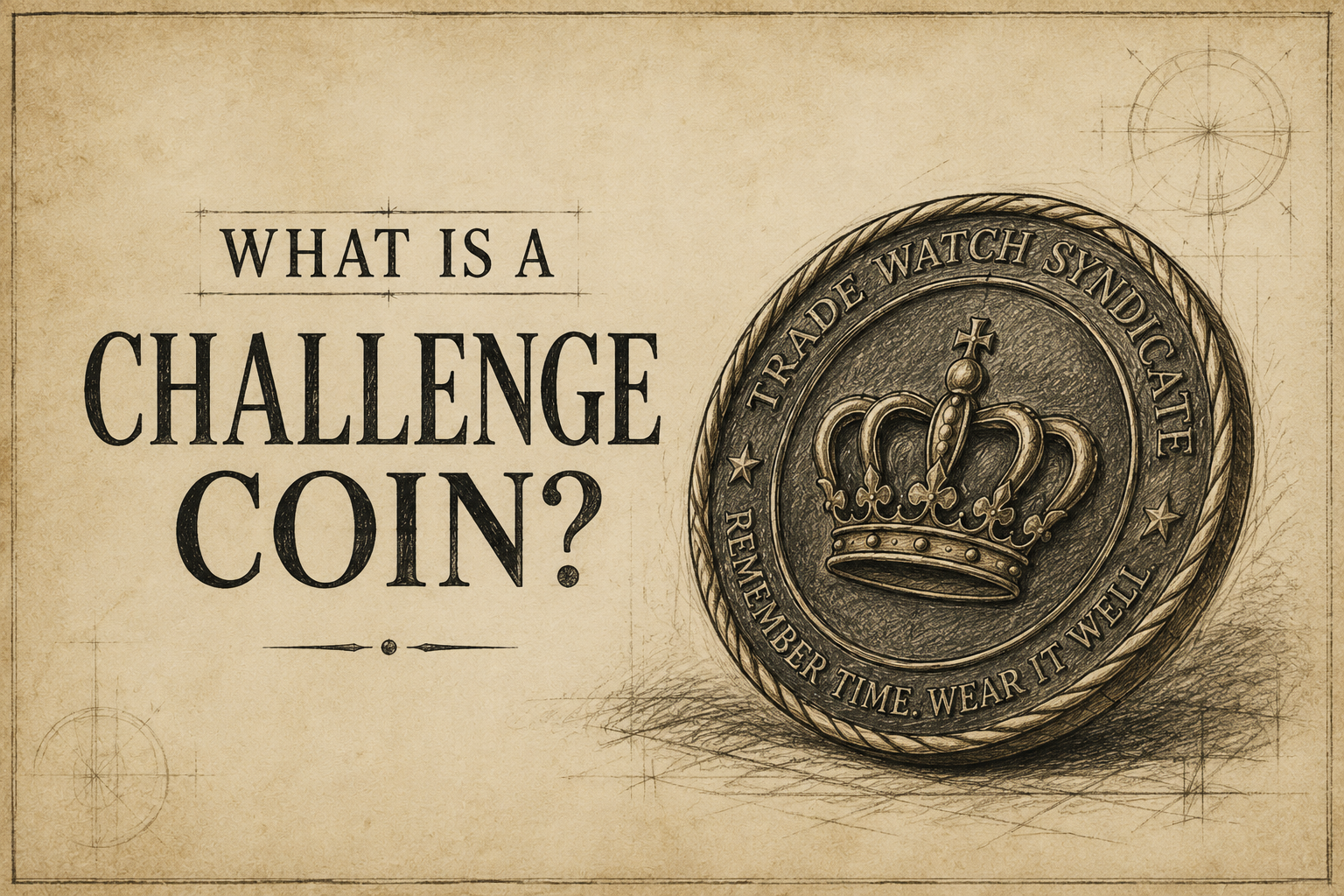
What Is a Challenge Coin?
From military tradition to personal meaning, challenge coins have carried stories for generations. Explore their history, the tradition behind the challenge, and how a small piece of metal can become a marker of service, belonging, memory and time.
A challenge coin is a small piece of metal that can carry a surprising amount of weight.
Traditionally exchanged within military units, first responder organizations and other groups, challenge coins have been used to recognize service, commemorate events, mark accomplishments and represent belonging. Some are earned. Some are given. Some are traded. And increasingly, some are simply collected because of the history, craftsmanship or story they represent.
But the coin itself has never really been the point.
What gives a challenge coin meaning is what — or who — it connects you to. A unit. A place. An accomplishment. A person. A moment in time.
That idea is part of what drew us to challenge coins in the first place.
They’re objects meant to be carried, handled and passed from one person to another. They can get scratched. They can develop wear. They can spend years forgotten in a drawer before suddenly bringing back a memory you hadn’t thought about in decades.
In that way, a challenge coin can become something more than a collectible.
It can become a marker of time.
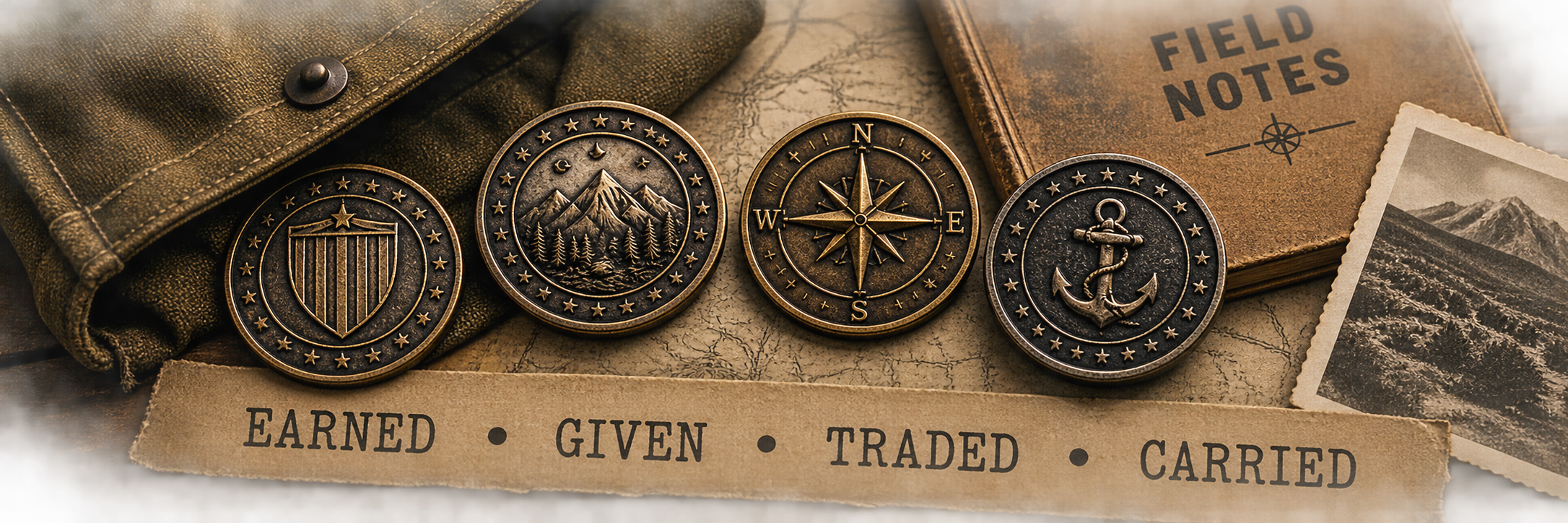
WHERE DID CHALLENGE COINS COME FROM?
The exact origin of the challenge coin is difficult to pin down. Like many traditions passed from one generation to the next, its history is a mix of documented practice and stories that have grown with the telling.
One of the most popular origin stories dates back to World War I. According to the legend, a wealthy American officer had bronze medallions made for the members of his flying squadron. One pilot carried his in a small leather pouch around his neck.
After being shot down behind enemy lines and captured by German forces, the pilot reportedly escaped, only to be detained by French troops who suspected he was a German saboteur. With no identification, he produced the medallion bearing his squadron's insignia. A French soldier recognized it, his identity was confirmed, and instead of being executed, he was returned to his unit.
It's a great story.
It's also almost certainly impossible to verify.
What we do know is that military units have a long history of using medallions, tokens and specially created coins to represent service, membership and shared experience. Over time, challenge coins became particularly associated with the U.S. military, where they were presented by commanders, exchanged between service members and carried as symbols of unit identity and recognition.
The tradition eventually traveled well beyond the military. Today, challenge coins can be found in fire departments, law enforcement agencies, government organizations, clubs, businesses and communities of nearly every kind.
The settings changed.
The idea behind the coin didn't.
THE CHALLENGE BEHIND THE COIN
The name challenge coin comes from a tradition often known as a coin check.
The rules vary depending on who is telling the story — which is probably part of the fun — but the basic idea is simple. Someone produces their coin and issues a challenge. Everyone being challenged has to produce theirs.
If you can't?
Traditionally, you're buying the drinks.
If everyone produces a coin, the person who issued the challenge may be the one picking up the tab instead.
There are plenty of variations. Some traditions involve placing or slapping the coin on a table. Others have rules about how quickly it must be produced, whether it has to be carried on you, or even what counts as a legitimate challenge.
But underneath the ritual is something more interesting than who buys the next round.
You carried the coin because you belonged.
It was a small, physical reminder of the people you served with, the organization you represented or the experience you shared. Having it with you meant something — and being challenged to produce it was a way of proving that connection.
Today, plenty of people own challenge coins without ever participating in a coin check. The tradition has grown far beyond that ritual.
But the name stuck.
MORE THAN MEMBERSHIP
Challenge coins may have grown from traditions of belonging, but their meaning didn't stop there.
Over time, coins became a way to recognize something worth remembering.
They've been presented to mark accomplishments, commemorate deployments and events, recognize exceptional work, honor service, welcome someone into a group and thank people whose contributions might otherwise go unnoticed.
Sometimes the meaning is obvious. A unit insignia. A date. A location. A mission.
Other times, the story behind a coin is known only to the person carrying it.
And that's part of what makes them interesting.
A challenge coin doesn't need to have monetary value to become valuable. Its worth can come entirely from who gave it to you, why you received it, or what was happening in your life when it found its way into your hand.
Years later, the details may fade. The coin doesn't.
Pick it up again and suddenly you remember the place. The people. The story.
The object becomes attached to the memory.
And in some ways, that's not very different from the watches we talk about here.
A watch can tell time.
A coin can sit in your pocket.
Neither description comes close to explaining why someone might keep one for the rest of their life.
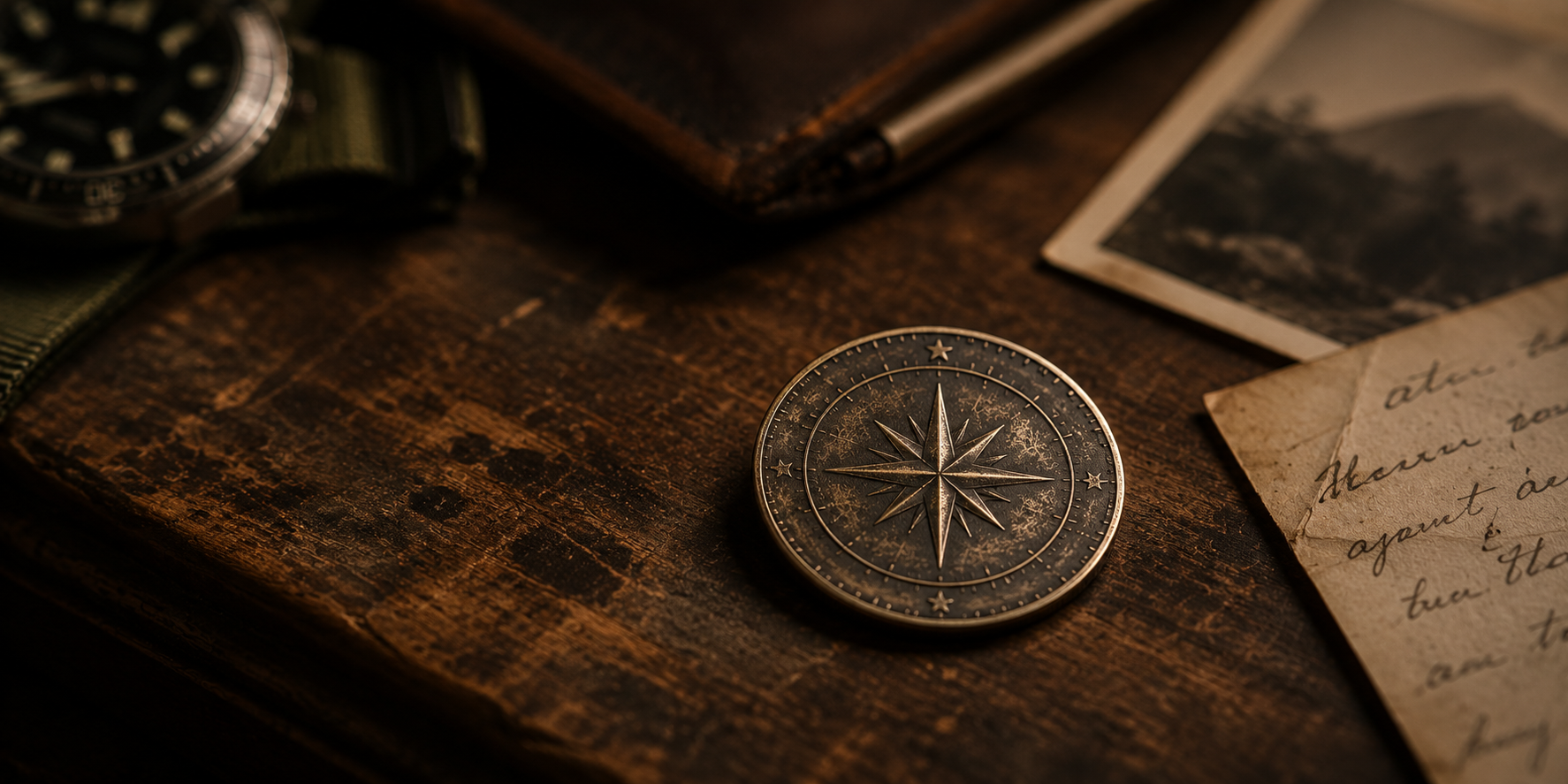
THE THINGS WE CARRY
Some objects earn a place in our lives that has very little to do with what they cost.
A watch handed down from a parent. A coin received after an accomplishment. A photograph tucked into a drawer. A gift that would mean almost nothing to anyone else, but everything to the person who received it.
We keep these things because they become connected to people, places and moments.
They become reminders.
That's part of what makes challenge coins interesting to us. Their history may be rooted in service and belonging, but the idea behind them is much bigger than any one tradition.
A small object can carry a story far larger than itself.
And perhaps that's why challenge coins have found a home far beyond the organizations that first made them popular. Today they're created for communities, events, milestones, causes and sometimes simply around an idea worth carrying.
The meaning doesn't have to be assigned by an institution.
Sometimes, you get to decide what the object means to you.
WHY WE MADE ONE
When Trade Watch Syndicate began, we knew we wanted to create something that could exist beyond a screen.
Something you could hold. Carry. Give to someone. Leave on a desk. Toss in a pocket. Find years later and remember exactly why you kept it.
A challenge coin felt right.
Not because we were trying to recreate the traditions that came before us, or claim a history that isn't ours. Quite the opposite. We respected what challenge coins have represented for generations, while believing the format could carry a different kind of message.
Ours started with two words:
Memento Temporis. Remember Time.
It's a reminder that time is limited — and that knowing that should change the way we use it.
The watches we wear measure time. The objects we keep can remind us of where it went.
Our first coin was created to live somewhere between those two ideas.
It wasn't designed to commemorate a unit, rank or organization. You don't have to earn it. There is no membership required to carry one.
It's simply a physical reminder:
Time is limited. Use it well.
Carry it. Give it away. Leave it somewhere you'll see it. Let it get scratched.
And someday, maybe it will remind you of a moment worth remembering.
Memento Temporis.
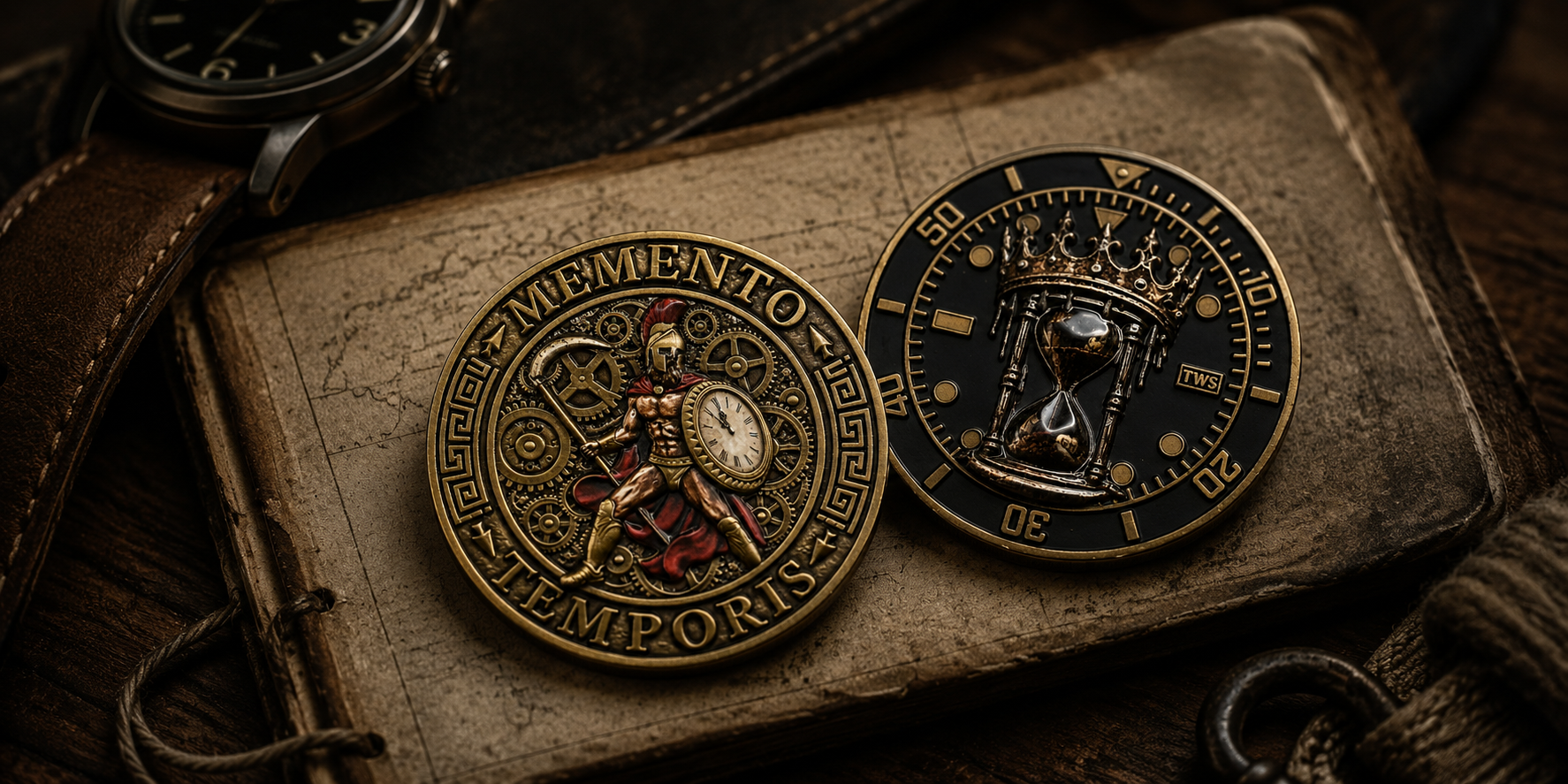
WHAT WE CHOOSE TO CARRY
A challenge coin can begin as a piece of metal.
What happens after that is up to the person who carries it.
Maybe it marks an accomplishment. Maybe it reminds you of someone. Maybe you give it away at exactly the right moment. Maybe it spends years in a drawer before you find it again and remember a version of yourself you haven't thought about in a long time.
That's the strange thing about the objects we keep.
We give them meaning, and eventually, they give our memories somewhere to live.
It's something I've come to appreciate more as I've gotten older. Some of the things that mean the most to me aren't important because of what they are. They're important because of who they remind me of, where they've been, or the moment in my life they've become attached to.
That's true of the watches I wear. It's true of the things that have been handed down to me. And it's part of why we made this coin.
I don't know where every Memento Temporis coin will end up. Some will probably sit on desks. Some will get carried. Some will be collected. Some will be given to someone else.
I hope they get scratched.
Because that means they went somewhere.
Challenge coins have carried stories for generations. The people carrying them have changed. The reasons for making them have changed. But perhaps that's exactly why the tradition has endured.
A coin is small enough to carry.
A story isn't.
Memento Temporis.
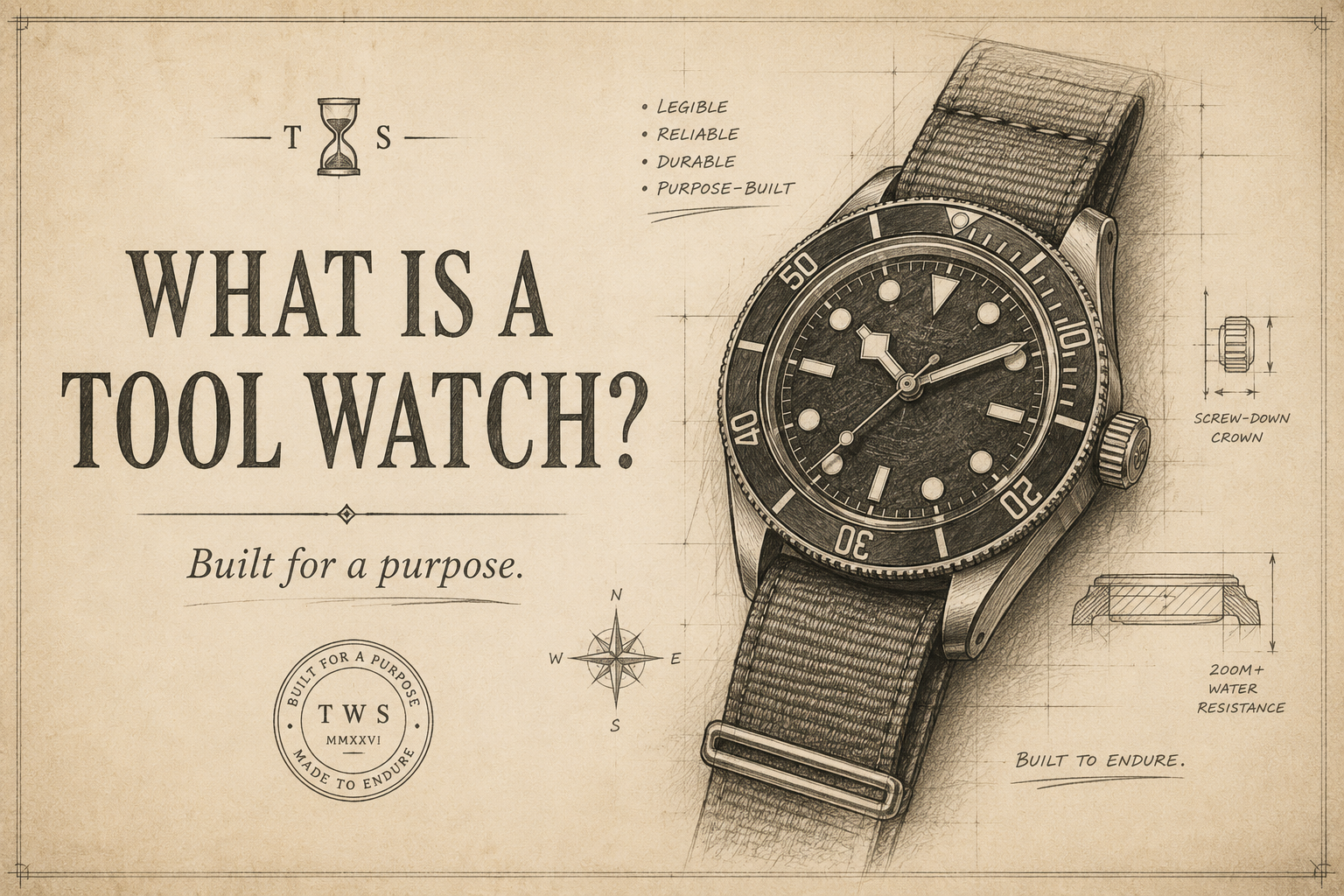
What Is a Tool Watch?
From dive watches and pilot watches to GMTs and chronographs, tool watches were built to do a job. Explore how purpose, environment and necessity shaped the watches we now call tools.
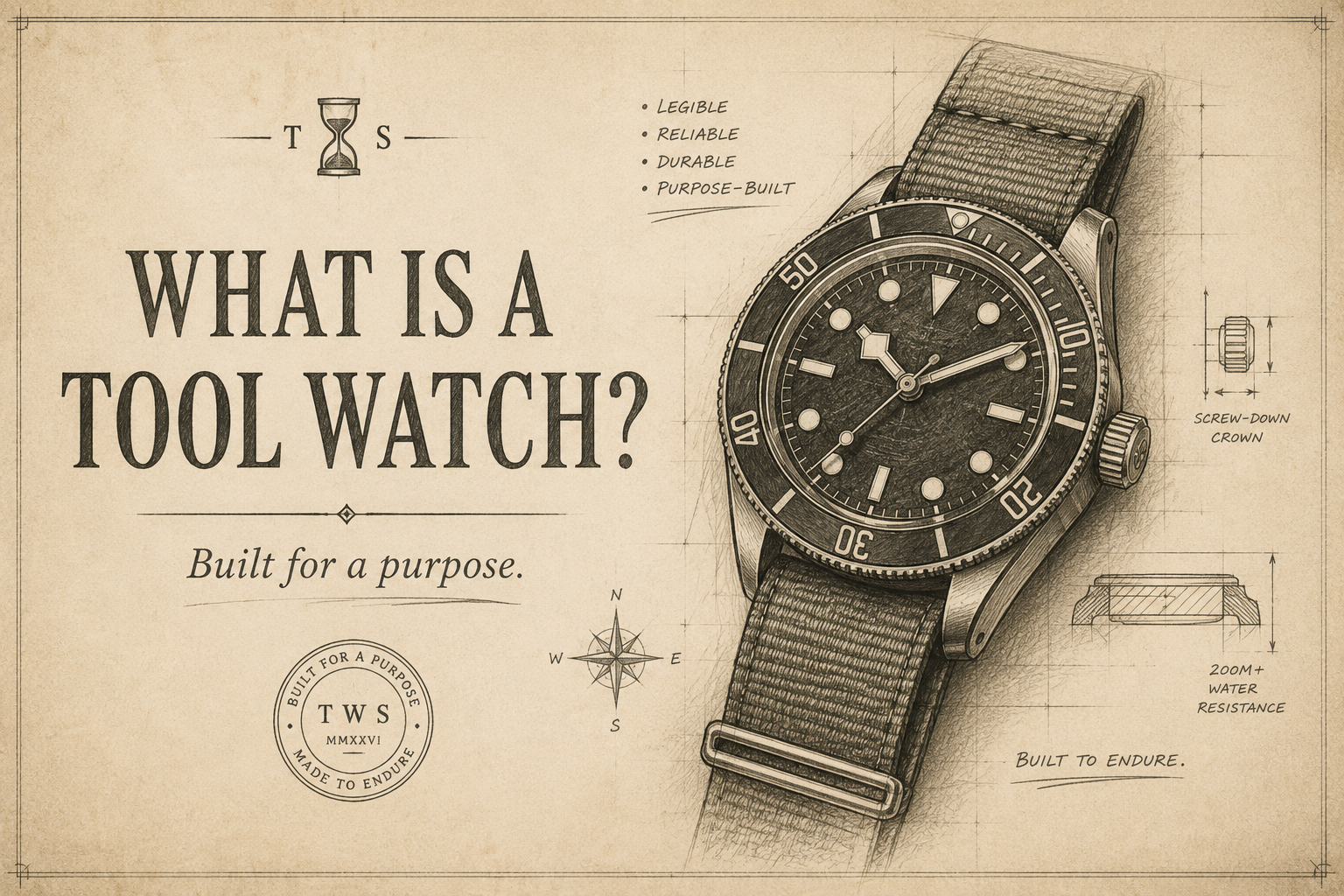
A tool watch is, at its core, a watch designed to perform a specific function.
Of course, you could argue that every watch is a tool—it tells the time. But tool watches go a step further. They were designed with a job in mind, whether that meant helping a pilot navigate, a diver track time underwater, a soldier read the time in the dark, or a traveler keep track of multiple time zones.
That purpose-first philosophy is what makes tool watches so interesting to me. They weren’t originally designed to sit in a display case. They were designed to be used.
Built for the Job
The idea of a tool watch is almost as old as the wristwatch itself.
In the early days of wristwatches, wearing a watch on your wrist wasn’t simply a matter of convenience or style. In many cases, it solved a very real problem: sometimes reaching for a pocket watch just wasn’t practical.
One of the most famous examples came in the early 1900s, when Brazilian aviator Alberto Santos-Dumont reportedly complained to his friend Louis Cartier about the difficulty of checking a pocket watch while flying. Cartier’s solution was a watch that could be worn on the wrist, allowing Santos-Dumont to check the time while keeping his hands on the controls.
Whether on the wrist of a pilot, soldier, diver, explorer, or traveler, the same basic idea would continue to shape watches for decades:
Identify the job. Build the watch to do it.
Over time, those jobs helped create some of the most recognizable categories of tool watches we know today.
Built for the Field
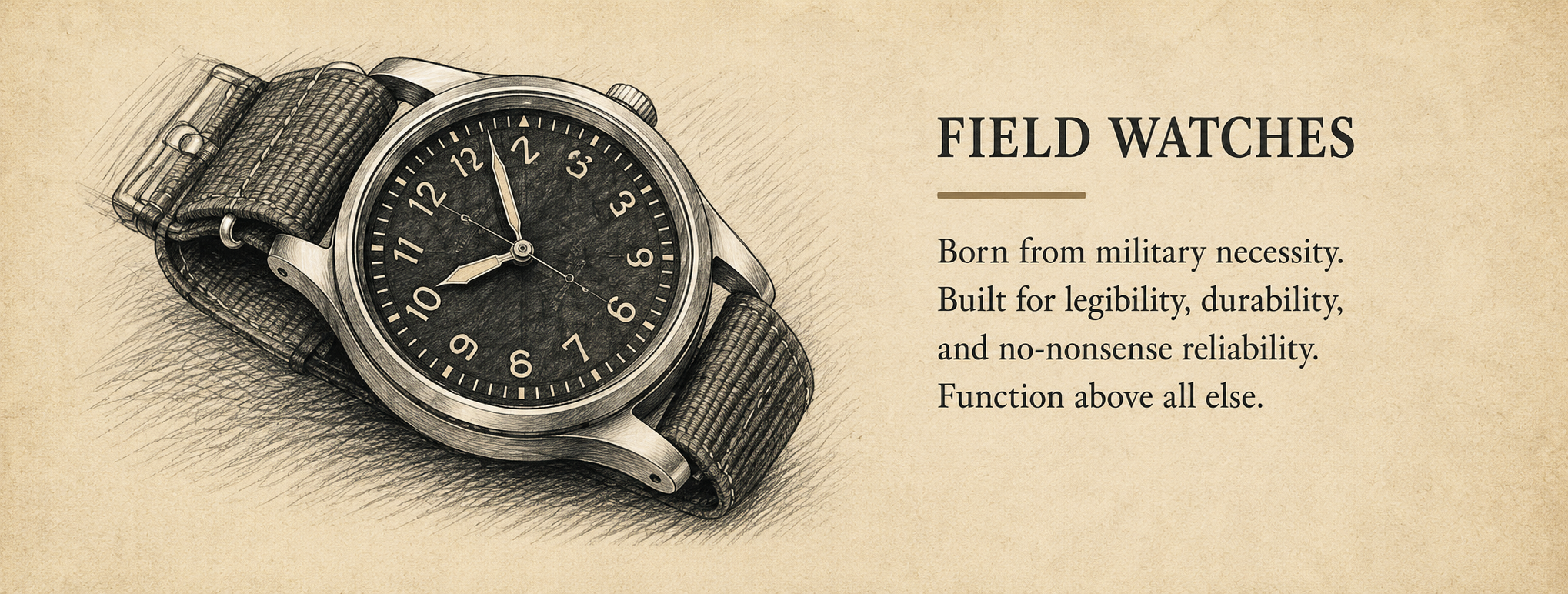
A field watch was designed first and foremost to be highly legible, rugged, and reliable.
Their history is closely connected to military use, particularly during the World Wars. Watches like the famous A-11 “Dirty Dozen” helped establish a design language that can still be seen in field watches today: simple dials, large numerals, easy-to-read hands, durable cases, and very little that doesn’t serve a purpose.
Modern field watches generally follow that same philosophy. Rather than complicated features or functional bezels, the emphasis is on an easy-to-read dial, a rugged movement, reasonable water resistance, and lume that allows the wearer to tell the time in darkness.
Historically, they’ve also tended to be modest in size and commonly paired with leather, canvas, or NATO-style straps. Most are straightforward three-handers: hours, minutes, and seconds.
Function above everything else.
I’ll admit, field watches aren't usually what I personally gravitate toward. But I genuinely appreciate their heritage and design. There’s something cool about a watch that makes absolutely no attempt to be anything other than what it needs to be.
That appreciation grew even more when I toured the U.S. Army National Infantry Museum and had the opportunity to see military watches on display.
Built for the Depths
A dive watch was designed around a simple but critical need: keeping track of time underwater.
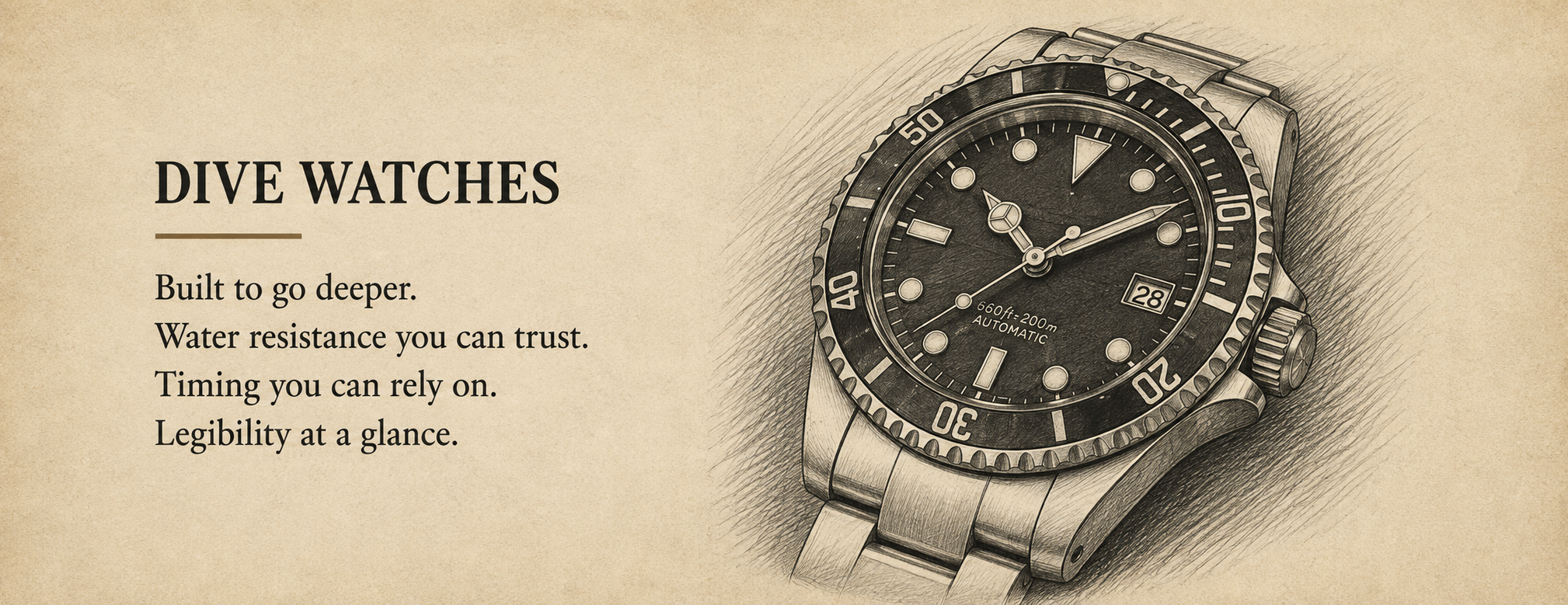
As recreational and professional diving grew in the 20th century, divers needed watches that could withstand increasing water pressure while remaining easy to read in dark, difficult conditions. That meant robust cases, strong water resistance, luminous hands and markers, and eventually one of the dive watch’s most recognizable features: the rotating timing bezel.
The bezel allowed a diver to track elapsed time underwater at a glance. Modern dive watches typically use a unidirectional bezel, designed to rotate in only one direction. If it’s accidentally moved during a dive, it can only indicate that more time has elapsed—not less. It’s a small design choice with a very practical purpose.
At the bezel’s zero marker, you’ll also typically find a luminous pip. Like the lume on the dial, it helps the diver see the bezel’s starting point in low-light conditions, making it easier to track elapsed time when visibility is limited.
Legibility matters just as much. Large markers, strong contrast, and generous lume help make the dial readable when visibility is limited. Screw-down crowns and robust case construction help protect the movement from water and pressure.
And while most dive watches today will probably never see anything deeper than a swimming pool, their design still reflects the environment they were originally built to survive.
There’s a reason the dive watch has become one of the most recognizable watch designs in the world. Even when you take it out of the water, every part of it still looks like it has a job to do.
Built for the Cockpit
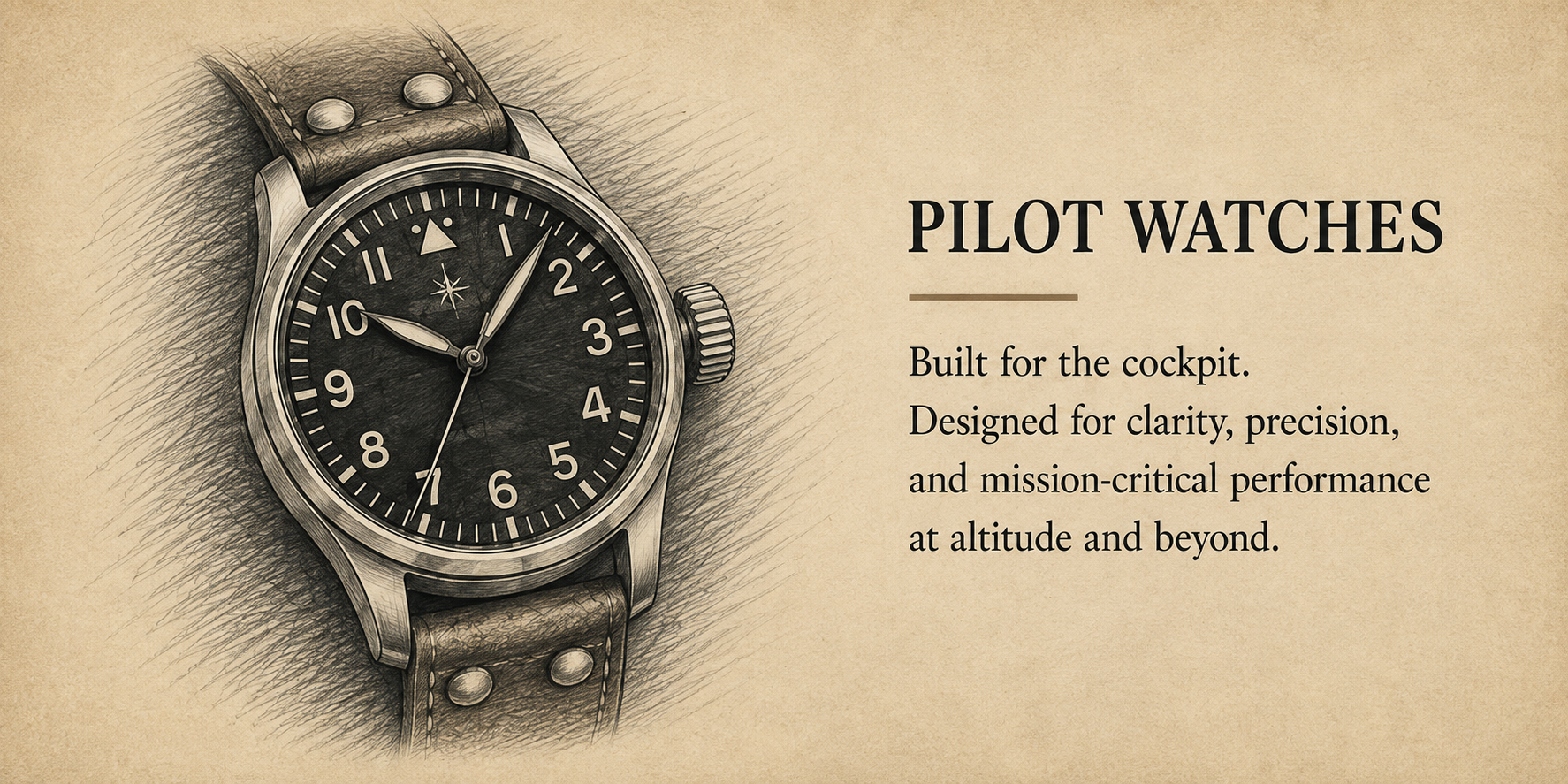
Pilot watches were born from a problem that seems almost obvious today: a pilot needed to know the time without taking their hands off the controls.
In the early days of aviation, that wasn’t as simple as glancing at your wrist. Pocket watches were still common, and pulling one out while flying an aircraft was hardly practical. As aviation evolved, so did watches designed specifically for the people in the cockpit.
Legibility became everything. Large dials, bold numerals, high-contrast hands, and luminous markings made it possible to read the time quickly in changing light and difficult conditions. Many early pilot watches also featured oversized crowns, allowing them to be adjusted while wearing gloves.
But time in the cockpit wasn’t just about knowing whether you were running late. Before modern navigation systems, pilots relied on time alongside speed, distance, and direction to help calculate their position and navigate a route. Later aviation watches added functions like chronographs, rotating bezels, and additional time zones as the needs of pilots became more complex.
Like the best tool watches, nearly every recognizable feature of a traditional pilot watch exists because someone needed it to do a job.
And there’s something I love about that. Many pilot watches are big, bold, and impossible to miss—but historically, that presence wasn’t about making a statement.
It was about making the time impossible to miss.
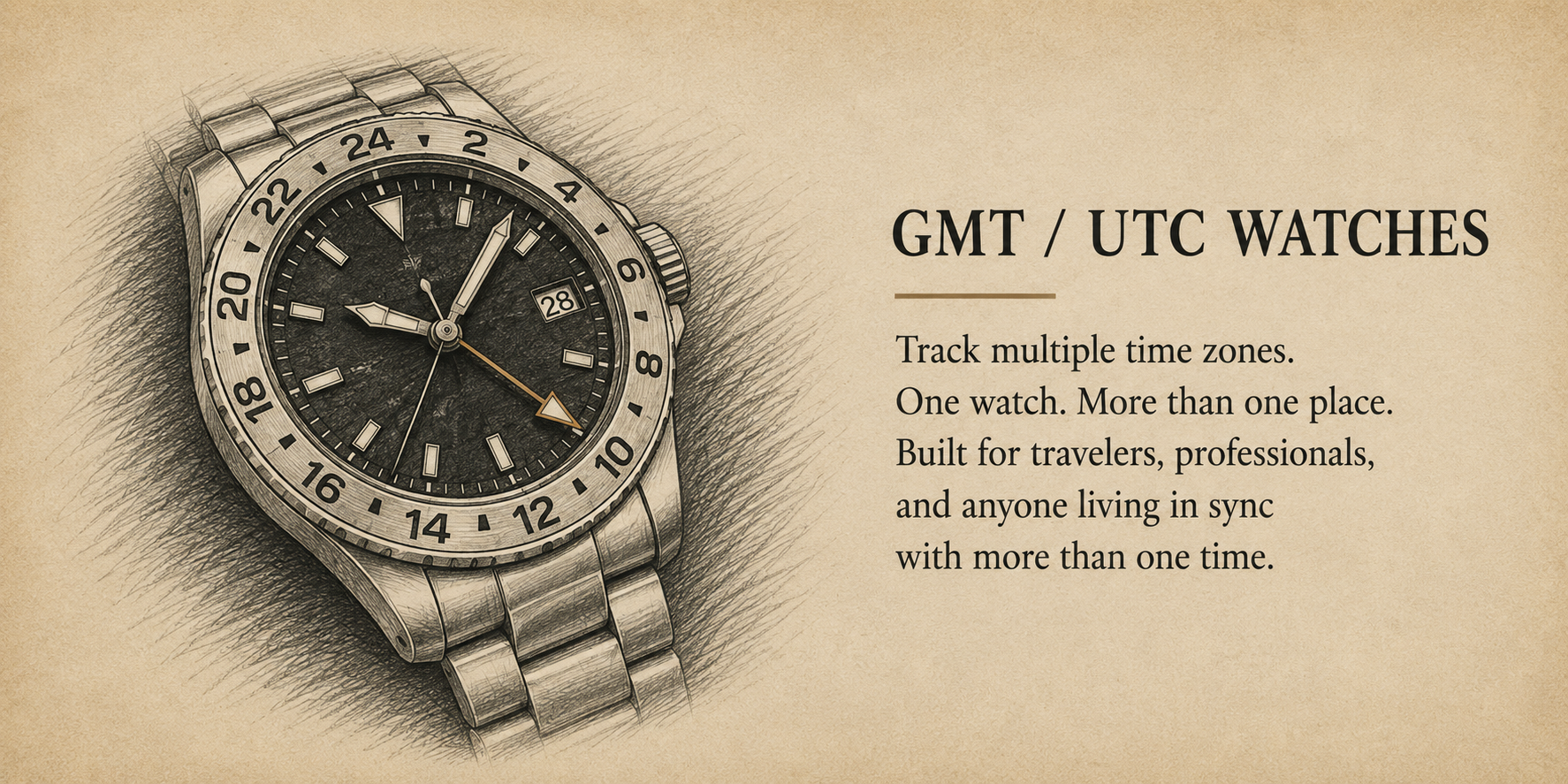
Built for More Than One Time Zone
A GMT watch was designed around a simple idea: keeping track of more than one time zone at once.
GMT stands for Greenwich Mean Time, while UTC — Coordinated Universal Time — is the modern global time standard. In the watch world, the terms are often used somewhat interchangeably when describing watches capable of displaying an additional time zone.
The defining feature is an additional hour hand, commonly called a GMT hand, that makes one full rotation every 24 hours. Paired with a 24-hour scale on the dial or bezel, it allows the wearer to read a second time zone alongside local time.
These watches became particularly useful as international air travel expanded. Pilots, crews, and travelers increasingly found themselves crossing multiple time zones, creating a very practical need to keep track of both local time and the time back home.
Some GMT watches take the idea even further. A rotating 24-hour bezel can allow the wearer to track a third time zone, turning a relatively simple mechanical concept into an incredibly useful travel tool.
One watch. More than one place.
This is one of those tool-watch complications I personally love because the function is immediately understandable. A GMT may be built for crossing time zones, but part of its appeal is simpler: no matter how far you travel, home is always there on your wrist.
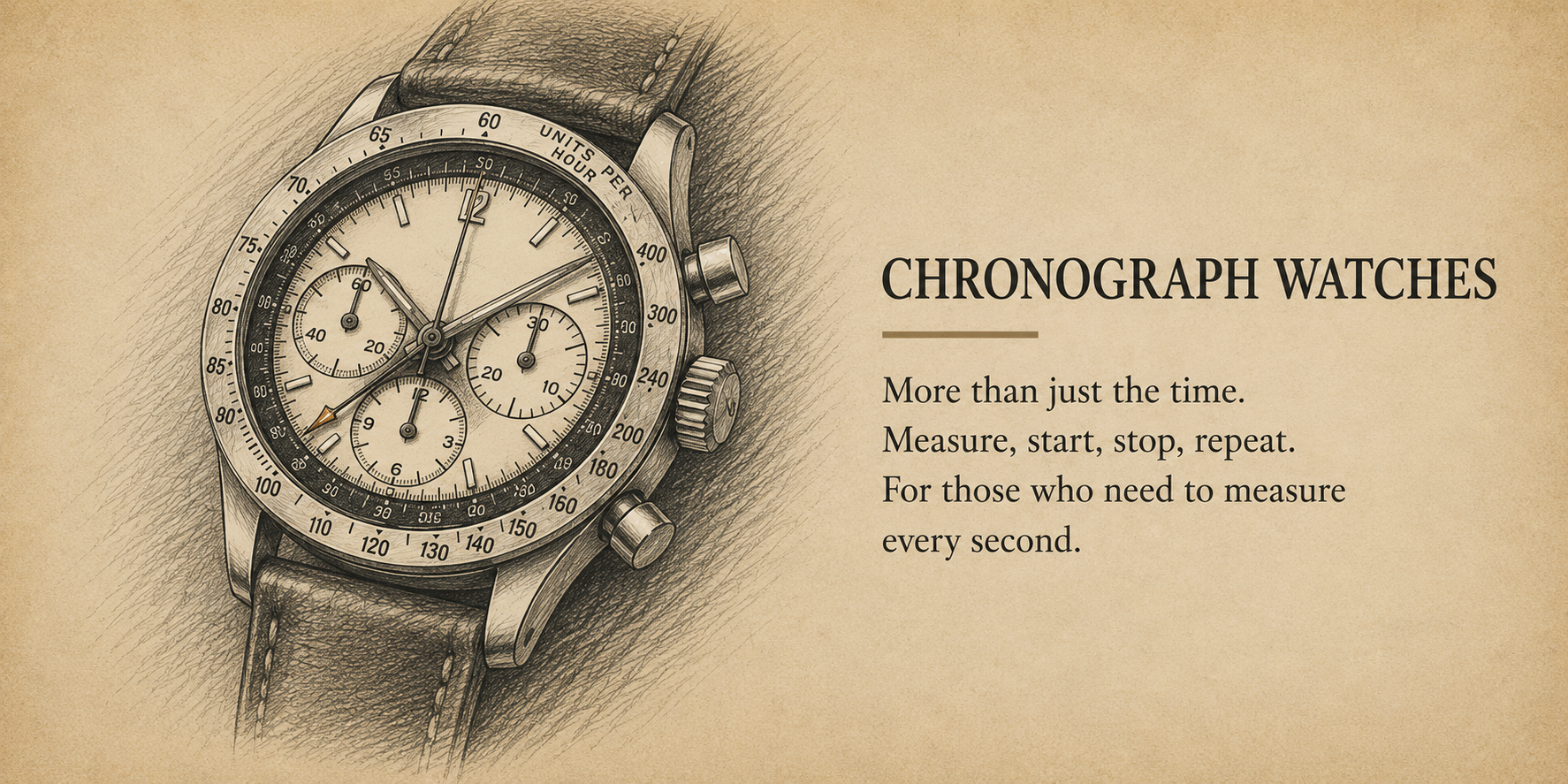
Built to Measure
A chronograph takes the basic function of a watch one step further. Instead of simply telling you the time, it allows you to measure elapsed time on demand.
At its simplest, a chronograph is essentially a stopwatch built into a wristwatch. Pushers on the side of the case allow the wearer to start, stop, and reset a separate timing mechanism, while subdials can record elapsed minutes and hours.
The complication became especially useful anywhere precise timing mattered. Chronographs found their way onto the wrists of pilots, racing drivers, engineers, military personnel, and even astronauts. Depending on the watch, additional scales could make them even more specialized.
One of the most recognizable is the tachymeter, which can be used with the chronograph to calculate speed over a known distance. Other chronographs have used scales designed for everything from measuring distance to monitoring heart rates.
And despite how complicated some chronograph dials can look, the underlying idea is remarkably straightforward:
Start. Stop. Measure.
I think that’s part of what makes chronographs so interesting. All of those subdials, pushers, hands, and markings aren’t just there for decoration. At least originally, every one of them had a job to do.
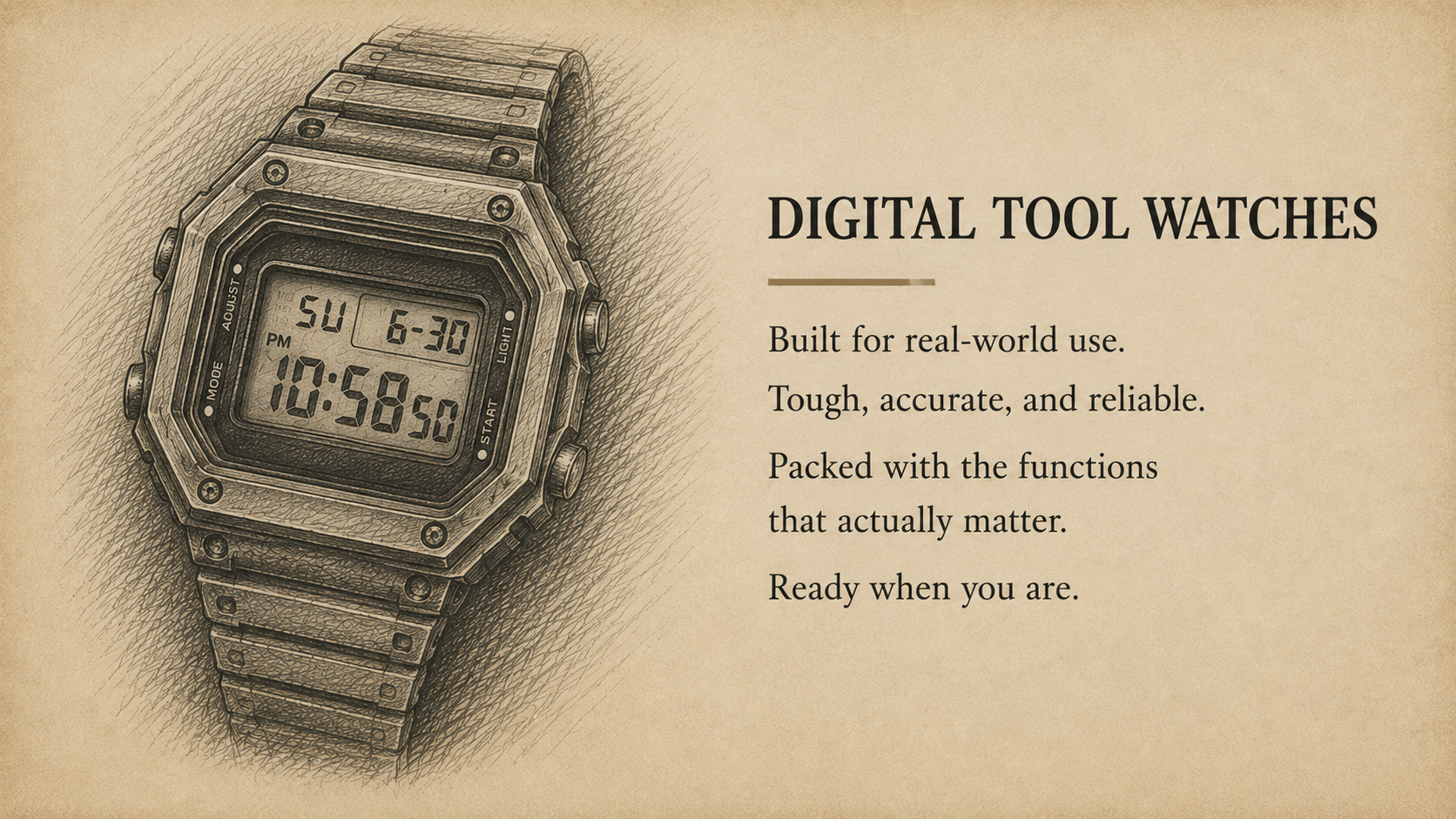
Built for the Real World
Not every tool watch has hands, gears, or a mechanical movement. Some of the most capable tool watches are digital.
Digital watches took the same purpose-first philosophy behind traditional tool watches and expanded what could be carried on the wrist. With quartz accuracy and a digital display, a single watch could provide multiple useful functions at once while remaining durable, reliable, and relatively simple to operate.
Stopwatches, countdown timers, alarms, backlights, calendars, and multiple time zones became common features. More specialized digital tool watches pushed the idea even further, adding functions such as compasses, altimeters, barometers, depth measurements, and eventually GPS.
Their usefulness also isn't tied to one particular environment. Digital tool watches have been worn by athletes, military personnel, first responders, divers, hikers, explorers, and everyday users who simply need something dependable on their wrist.
And that's part of what makes them interesting. A tool watch doesn't have to be mechanical. It doesn't have to be expensive. And it certainly doesn't have to be luxurious.
Different watches. Different environments. Same basic idea:
Give the wearer the information they need, when they need it.
There's something refreshing about that simplicity. Digital tool watches aren't trying to impress anyone. At their best, they're designed to work, take a beating, and be ready when they're needed.
That, as much as anything else in this article, is what makes a watch a tool watch.
So, What Makes a Tool Watch?
A field watch and a dive watch may look completely different. A chronograph may be filled with subdials while a digital watch displays everything on a screen. One was built for the battlefield, another for the ocean, another for the cockpit, and another simply to keep track of more than one place at a time.
But they all share the same philosophy:
Purpose comes first.
A tool watch was designed to solve a problem. Its features exist for a reason. Legibility matters. Reliability matters. Durability matters. And whether that means a rotating bezel, a GMT hand, a chronograph pusher, luminous markers, or a digital display depends entirely on the job it was built to do.
Today, most of us probably aren't using these watches for the jobs that originally inspired them. A dive watch might never go deeper than a swimming pool. A GMT might spend its entire life in one time zone. A chronograph may be used more often to time dinner than a lap around a racetrack.
And that's okay.
Because part of what makes tool watches special is that their purpose doesn't disappear just because our reason for wearing them has changed. The history is still there. The function is still there. And the idea behind them is still there.
They were built to be used.
And I think they still should be.
Wear the watch. Make the memories. Remember the time.
Memento Temporis.
Finding the right watch size isn't just about case diameter. Lug-to-lug, thickness, case shape, wrist size and even how you view the watch can completely change how it wears. Here's how to find the size that works for you.